Showing posts with label sacrament. Show all posts

Monday, April 15, 2024

REFUTATION OF THE HERESY OF THE WATER

Things can be said so simply but taken so complicatedly.  For instance, Jesus commanded the eleven apostles to represent Him when He gave them final instructions for after His ascension: 

(KEY VERSE) Go you therefore, and teach all nations, baptizing them in the name of the Father, and of the Son, and of the Holy Ghost. (Mat 28:19)

 He began with “Go you therefore.” He was telling them to go somewhere. Surely, that was the Way that He had gone. He Himself had come into the world and baptized many, but in Spirit, not in water. He had set the example. However, there was one disconnect; He did not command a mode of baptism, at least directly; He merely reminded them of what He had just said, to wit: “All Power is given unto Me in heaven and in Earth” (Mat 28:18). It was Power from Him and not any other substance.

They were to tell them about the Power of Jesus; tell them by teaching people from all the nations of the world. The word, “therefore,” was the pointer to the previous words about His own Power.

It was not just to a select few but everyone that they would encounter.

Now consider the first mode of baptism that the prophets wrote about: 

 Prepare you the Way of the Lord, make His paths straight. John did baptize in the wilderness and preach the baptism of repentance for the remission of sins. (Mark 1:3-4)

 John prepared the Way for Jesus. His way was preparation, but was not the Way. John did baptize in the wilderness “and were all baptized of him in the river of Jordan, confessing their sins” (Mark 1:5).

The action therein was water baptism, not for the remission of sins, but for repentance in preparation for the remission of sins. They were to confess to the onlookers of what sins they had repented. (You seldom hear that confession, so the baptism must be a vicarious way of confession.)

That a sinner was baptized in water is a confession rather than a remission. It is like a criminal that confesses to the crime before the judge removes the penalty. John instrumented the confession, but Jesus the remission of the crimes against God and humanity.

So, John did baptize in water; that is a fact, but John is not Jesus who never baptized in water. Mark wrote, “I indeed have baptized you with water: but He (Jesus) shall baptize you with the Holy Ghost” (Mark 3:6). Therein are two modes of baptism — water and the Holy Ghost which Jesus referred to as, not just water, but “Living Water” that even flowed.

Jesus said to the sinful woman at the well: 

If you knew the gift of God, and who it is that said to you, “Give me to drink; you would have asked of Him, and He would have given you living water." (John 4:10)

 Jesus is the ‘fountain of Living Water’ and baptism would be in Him. However, the Person Jesus left, leaving behind the Holy Ghost as the “Comforter” who would abide with them forever (John 14;16). The Holy Ghost is the ‘Living Water’ that is always present, even forever afterwards.

The eunuch asked Philip, after he believed, “See, here is water; what hinders me to be baptized?” Then they went down in the water for the eunuch to be baptized. If the water had not been there, water would have hindered the eunuch. Note that the eunuch had confessed no sins for him to even be baptized in water. The baptism in water was THE confession.

Something miraculous happened after the eunuch was baptized that is often forgotten; “The Spirit of the Lord caught away Philip” (Acts 8:38). The Holy Spirit — the Holy Ghost of Jesus — had been there. The Holy Ghost, unbeknownst to Luke who wrote that account, had baptized the eunuch, but after the confession — the baptism in water. The efficacious baptism was not the water but the baptism of the Holy Ghost. The water prepared the Way of the Lord!

Jesus did baptize! His Holy Ghost still does, but Jesus never used the water mode of baptism; always using Living Water from His own ‘belly’ so to speak.

In fact, Jesus baptized the ground (Adam in the Hebrew), the soldier who pierced His side, and surely the repentant thief when His Divine Blood gushed forth onto those who believed. The Living Water from His belly regenerated Adam, most certainly, as “many bodies of the saints which slept arose and came out of the graves” (Mat 27:52-53). One of those “saints” would have been Adam since Calvary was the place of the skull (of Adam). Adam was the first saint because God had grace on him with His coat of skin (Gen 3:17).

Speaking to the apostles and some of their mothers, Jesus asked a pertinent question, “Are you able to drink of the cup that I shall drink of, and to be baptized with the baptism that I am baptized with?” (Mat 20:22). Only Jesus had been baptized with the Holy Ghost because the water in which He stood was of no effect since Jesus had not sinned and had no need to confess. The Baptism of Jesus was not of John nor water, but of the Holy Spirit and Power of God.

John said about Jesus, “He that sent me to baptize with water, the same said unto me, ‘Upon whom you shall see the Spirit descending, and remaining on him, the same is He which baptizes with the Holy Ghost.” (John 1:33).

John did baptize with water, then died. Water baptism should have died with him! Baptism of the Holy Ghost remains with us who confess our sins to this day. Water hinders the sinner! Why wait on water, when Living Water is always available. Why confess with water when you are always there to confess. The woman at the well was after real water when her thirst could only be satisfied by drinking the ‘Water’ of Jesus.

Jesus’s mode of baptism is substantial and always present since God is omnipresent; that is because wherever Christians go, the Holy Ghost is always there to baptize.

Jesus said to his followers, “I am come to send fire on the Earth; and what will I, if it be already kindled? But I have a baptism to be baptized with; and how am I straitened till it be accomplished!” (Luke 49:50). The baptism of Jesus was by “fire” (Acts 2:3), or in Power just as in the Key Verse.

Now consider Paul who denied that he had baptized in water: 

Then said Paul, "John verily baptized with the baptism of repentance, saying unto the people, that they should believe on Him which should come after him, that is, on Christ Jesus." (Acts 19:4)

 Who were they to confess, John or Christ Jesus? The baptism of John in water indeed confesses John who was unworthy compared to Jesus, but they compared to the baptism of John belief in the baptism of Jesus that is by His Power, in the Key Verse — the Holy Ghost.

Have you ever wondered why? Why… why “he that shall blaspheme against the Holy Ghost has never forgiveness, but is in danger of eternal damnation?” (Mark 3:39). That is because those who profess the power of water baptism trespasses against the Holy Ghost — the ‘Instrument” of true living water baptism.

There are three substances of the Godhead, according to the key verse: Father, Son, and Holy Ghost in whose Name people are to be baptized. They are the three modes of baptism. The Jews baptized, confessing in the Name of the Father, Yahweh, in the molten sea in water (1 Kings 7:23); Jesus baptized those who confessed Himself in His Power; and the Holy Ghost baptizes those who understand that the Holy Ghost is as much the Spirit of Yahweh as Jesus is the Person of Him.

So many wanted to be baptized in water because theretofore they saw that was what the holy priests had done since the Exodus.

“For the Jews require a sign” (1 Cor 1:22). The sign for the Jewish confessors was water. So, it is with a small body of Christians that are very Jewish indeed! “He is a Jew, which is one inwardly; and circumcision is that of the heart, in the spirit, and not in the letter; whose praise is not of men, but of God” (Rom 2:29).

Those who insist on the letter of the Law, not the Spirit, are Jews inwardly. Many thinking that they are the only Christians are the remnants of Judaism who must have some thing to worship God.

Water has become the manifestation of ‘god’ to many; Jesus was not even required, so long as water was always plentiful. With Jesus gone, so long as there is water, those who call themselves Christians, are as much, Poseidons.

To be honest, those who belong to the Churches of Christ are very diligent and hard workers for their doctrines that they even dismiss as doctrinal. They indeed are inwardly Jews because they still think trekking down to the river’s bank is the one essential work that earns heaven. It is what they do, not what the Spirit of Jesus does. They have become the ‘gods’ that judge who is worthy and who is not. They are very Jewish indeed!

Don’t get me wrong; they indeed are serious and well-intentioned, but so were those who crucified the Savior, who Jesus said, “They know not what they do.” Jesus will excuse them for their ignorance, but there is no reason that other Christians should remain as ignorant as them.

One last word of caution; when baptism is mentioned in scripture, ask yourselves, “Whose baptism; John’s or Jesus’s?” Scripture says that there are, “One Lord, one faith, one baptism” (Ephes 4:5). Ask yourselves, (1) Who is Lord? John or Jesus? (2) faith in whom? water or the Power of the Spirit? and (3) whose baptism? The Holy Ghost’s or water?


Thursday, June 1, 2023

PRESERVING THE SALTED OFFERING

Some things are often glossed over when reading the Bible like an ordinary book. Every word was breathed by the breath of God. His Holy Breath breathes life unto the Bible just as it did with Adam that makes the Bible the “Living Word” of Himself. In other words, Jesus remains alive in Heaven and His Spirit alive on Earth through the Bible. He still speaks with another inaudible sixth or seventh sense.

Because it is metaphorical the following passage is often glossed over. Sure, you have heard it said, but do you know its significance: 

(KEY VERSE) Ye are the salt of the earth: but if the salt have lost his savour, wherewith shall it be salted? it is thenceforth good for nothing, but to be cast out, and to be trodden under foot of men. (Mat 5:13) 

Jesus is speaking of Christians — the blessed. He identified the blessings as the “reward” that they would obtain in heaven (verse 12). Get that; heaven is the reward! Why is that? It is in the realm in which Christians are saved. Salvation is the reward.

Heaven is not a physical place but another realm wherein the soul never dies. The Book of Enoch reveals that Heaven is divided into two realms: Hell and Paradise with a “great gulf” between them as Luke 16 validates. So, the reward in Heaven is Paradise and the punishment in Heaven is Hell. In either place, the soul never consummates death, but in one it is “gladness” and the other sadness and torments.

Heaven is for real but of a different substance. It is the place of souls. My own hypothesis is that the creation of Genesis chapter one is making of the souls in Paradise, and chapter two the physical bodies in the Garden of Eden. They are the same place, if I am right, but different realms. The “door” to heaven is the portal from here to there: 

Behold, I (Jesus) stand at the door, and knock: if any man hear My voice, and open the door, I will come in to Him, and will sup with him, and he with Me. (Rev 3:20)

 Jesus stands at the door, or “portal” by the Way to the Tree of Life (Gen 3:24). The cherubim keep the Way, but Jesus is the Way, and indubitably the Tree of Life at the end of the Way. Jesus said this about the Way: 

To him that overcometh will I give to eat of the Tree of Life, which is in the midst of the paradise of God. (Rev 2:7)

Overcome what? The elements of the world that dilute the salt. 

There is a point to this; The Tree of Life is the reward in Heaven and Jesus is the “true vine” (John 15:1) of that Tree (alethinos ampelos). “Alethinos is the “nature” of whom? The Husbandman, Jehovah. Ampelos is most often translated “vine” but it has two parts: (1) “both of two, both the one from the other,” hence vine, and (2) “a threshing floor” (Strong 1890). In other words, Jesus is not literally, or even figuratively, a “vine,” but from Jehovah God Himself, and He is both from God and God. That He is from God comes from the threshing floor whereon the Temple was made for God to reside.

Jesus is compared to the “Vine” because He Himself was the “Good Grain” that remained after the tares and offal were discarded on the threshing floor. The tares were those of the Wicked One and the offal were those who were to be sent to Hell in the realm of Heaven.

As such Christians will be judged as well. Jesus will thresh them out; “The Judge is standing right at the door” (Jas 5:9).

The pieces are all coming together. The “Judge” is Jesus, and it is Him that is standing to the portal between this world and the other world, but what about the key verse, Matthew 5:13?

The “salt” as translated from “halas” in the Greek. The significance of that is, “For every one shall be salted with fire, and every sacrifice shall be salted with salt” (Mark 9:49).

Thus, the salt of the Earth is for the sacrifice. What does salt do? It preserves the flesh of the sacrifice. All the offerings of the Israelites would be offered by salt (Lev 2:13) for preservation to remain good. Speaking of all the heave offerings God said, “By a statute forever: it is a covenant of salt for ever before the Lord unto thee and to thy seed with thee” (Num 8:19). That Covenant remained with Jesus.

Of course, Christians offer themselves; Paul wrote, “Ye present your bodies a living sacrifice, holy, acceptable unto God” (Rom 12:1). Your bodies — your flesh — must be seasoned with salt. Not the salt of the earth but sprinkled with salt in a spiritual sense. Salt is a base word in the Greek, and it means “prudence” in a figurative sense (Ibid) — “caution or circumspection as to danger or risk” (Merriam-Webster Dict. 1828-2022).

If that definition applies, then “the salt of the earth” is prudence in the world (ge). The world is not the planet Earth but the cosmos (kosmos), meaning this realm. Those “salted” must beware of spoilage.

With salted meat of any type there is a risk. Is it ample for the preservation and is it applied all over? Does the salt lose its savor? No, but it can be diluted and even washed off by other elements of the world.

As such, Jesus salts the Christian to last forever, but care must be taken with prudence to ensure that the salt remains where Jesus placed it and all over.

Savor is a sixth sense. It is a distinctive quality that can be sensed. It may still be there but is diluted a little bit at a time until the salty taste is gone.

What does a chef do when there is too much salt? Wipes off what is not absorbed and/or dilutes it with water from the faucet. Losing the savor of the salt is from things you do to make it of less quality, and with enough of your doings the savor is depleted, and the cured meat (you) is exposed to the world to end the preservation process.

It loses it savor “wherewith it is salted.” Who did the salting? Jesus. He provided the Covenant of Salt and those salted tamper with the preservative until it loses its effectiveness with imprudence.

Not the salt, but the flesh that was salted “is thenceforth good for nothing, but to be cast out.” That is the “threshing floor,” and to validate that, Jesus added, “to be trodden under foot of men.”

Mankind still does the treading to separate the tares and chaff from the good things, but Jesus judges. He winnows the offal from the good grain. But offerings are not only grain but meat offerings. He threshes out the preserved flesh from the flesh that loses its savor.

Previously the heave offering was mentioned. It was salted, then raised up and down to sacrifice it to the Lord. After that, it was acceptable as food for the officiating priest to use. He need not resalt it to eat of it because its savor remained. It was preserved meat that would be good for the priest to eat. Likewise, Christians who sacrifice themselves have the savor to be offered to the LORD GOD and must retain its savor for Jesus — the High Priest on the order of Melchizedek — to partake.

The lesson learned is that you are preserved as a Christian but must “Be sober, be vigilant; because your adversary the Devil, as a roaring lion, walketh about, seeking whom he may devour” (1 Pet 5:8). You are safe but not saved until the reward.

Therefore, before Jesus gets His supper — the salted meat — before losing its strong savor, is can be eaten by the Devil before the meat gets to its place in front of Jesus. Prudence is being sober and vigilant that you do not lose your “salt” because the “salt” that Jesus preserves with would never lose its savor without you being the unwary one.

Yes, Jesus preserves the Christian and they are safe unless they themselves despoil the sacrifice. If the savor remains and the flesh remains unspoiled, then the reward — preserved flesh — is the reward. However, the meat is not for the Devil but in the end, it is preserved for Jesus. Christians must remain cautious continually, or our flesh will gradually have its “salt” reduced to nothing by the world.

Jesus salts it; and we must retain the salt that He used. But fortunately, we are blessed, “Blessed are the pure in heart: for they shall see God” (Mat 5:8). That “salt” is the “heart” or our nature in synchrony with Jesus. That nature must remain pure for the blessing to come.


(picture credit: Dickey Bub)


Saturday, September 3, 2022

MELCHIZEDEK - Part 2

After considering the account from the Book of Enoch, Melchizedek becomes very significant, and is the importance of genetics. From chapter sixty-eight about, “Enoch, his own favored servant, even so that they might hand it on to their own sons, from generation to generation, from age to age.” Enoch was favored. He was not only shown mysterious scientific knowledge but neither would he ever die.

Enoch had been taken up to heaven, came back and wrote it down, and then returned to heaven without ever experiencing death. The people celebrated at Akhuzan where Enoch was translated into Paradise. Hence, for them, Akhusan was made a holy place as demonstrated by the alter there in front of which they celebrated three days. They surely celebrated Akhuzan as the entryway to heaven, and that because Enoch went to heaven, their hope forthwith was that access to heaven would be right there at Akhuzan.

The hope from Enoch’s experience in heaven and defeating death was that it would be genetic for all generations, or that his sons would be engendered from above (born again) in the same fashion.

Joseph, as supposed, was the father of Jesus. Luke wrote the genealogy of Joseph back to God, and it was through Enoch (Luke 3). It was supposed that Enoch passed down his genes many generations to Joseph, the alleged father of Jesus, but it was through Mary.

Thus, Jesus was the generation that would experience translation in the same manner as Enoch. However, Jesus, unlike Enoch, experienced death, but after he was Resurrected, he arose from that same City of Enoch, Zion. Akhusan is likely Zion, and hence, Jerusalem was not the City of Enoch but a celestial city above that was later called “New Jerusalem:”

Him that overcometh will I make a pillar in the temple of my God, and he shall go no more out: and I will write upon him the Name of my God, and the name of the city of my God, which is New Jerusalem, which cometh down out of heaven from my God: and I will write upon him my New Name.” (Rev 3:12)

 It appears that God’s old Name was Melchizedek, and His new Name was Jesus! Now back to Enoch.

What did Enoch do? He overcame the world when he was taken to heaven without suffering death. Because Enoch did so, so can the living children of God at the rapture; after the dead in Christ are glorified, those still alive in Christ will be translated to heaven (raptured like Enoch).

Enoch had parents and as such he was not the Messiah. However, with Enoch gone, God did supply a replacement on Earth for him. His new name was Melchizedek. He came from the City of God, the same great city of Zion — the City of Enoch that truly exists nowhere but in heaven.

Rather than the people celebrating Enoch, in effect, they were celebrating Melchizedek, who can be deduced as an appearance of God in the Flesh. He was as much “Jesus” as Jesus himself because he was God manifested in the flesh. However, there was one big difference; Melchizedek was a God in imperishable flesh, but Jesus wore perishable flesh so that He could feel the “sting of death.”

Good Friday was good for several reasons: (1) Satan lost his host, Judas, that day when he suffered death as well, (2) mankind was supplied with new genes that day and with a new name — Christians, and (3) The flesh of Jesus experienced the “sting of death.”

When anyone thinks of a “sting,” they think of bees or perhaps pricking of some sort. Paul was accused of Jesus of some act, “Saul, Saul, why persecutest thou Me? it is hard for thee to kick against the pricks” (Acts 26:14).

On a personal note, I thought about the sting of death. Before, I thought of death as a sting that would hurt terribly, but it occurred to me out of the blue, that the sting of death, for some, would be pleasant. Since “to die is gain,” for Paul (Phil 1:21), that implies that the sting of death for Paul and others in Christ is pleasant. Then it struck me; the sting of death is experiencing the Divine Impulse as the person is regenerated at rebirth. I had always thought that born again was on Earth, but discovered that for those in Christ, rebirth is at death: “Being born again, not of corruptible seed, but of incorruptible, by the word of God, which liveth and abideth for ever” (1 Pet 1:23). Hence rebirth is when the new flesh is acquired after death. The “sting” is when the genes of God are Divinely acquired which should be quite joyful!

Enoch was “born again” without ever dying. The Divine Impulse of God made his flesh incorruptible, and that condition has been passed down genetically to this day. Those who trust God need not fear, like Enoch, if Jesus would come down again, like Melchizedek, the sting would not kill but overcome death.

Enoch could not save others because he was not the Messiah. He did not even save himself. God provided the Divine Impulse as Enoch was “stung” by God but never died. There was a need for a Messiah, and before the Earth would be destroyed, the Messiah came to save the world!

In chapter sixty-nine, the people asked Methuselah to be glorified — to put on incorruptible flesh. Although that man would live longer than any other, 969 years, so long as that is; it is not eternal life. Methuselah lived so long as it would take, and it would be Melchizedek who would save mankind.

Melchizedek would arrive glorious from another realm just in time to prepare Noah for the crucial event; that God “gave his only begotten Son, that whosoever believeth in Him should not perish, but have everlasting life” (John 3:16). Only Noah found grace (Gen 6:8) but like Adam long before, he provided his own virtue to his sons, genetically. Noah had felt the Divine Impulse without dying like Enoch and passed it along genetically to his sons, just as the people worshipping at Akhusan had requested of Noah.

And God was faithful — Noah, and his brother Nir were the progeny of Enoch. Each would serve a purpose: for Noah, “his same shall comfort us concerning our work and toil of our hands, because of the ground which the Lord hath cursed” (Gen 5:29). “And Methusalam summoned Nir, the son of Lamekh, Noe’s younger brother, and he invested him with the vestments of priesthood in front of the face of all the people, and made him stand at the head of the altar of the LORD … He will be in front of your face from the present day as a prince and a leader.”

So, there were two bothers with two purposes: Noah was to build the ship to safety and Nir had a special, princely-priestly assignment. Nir was the priestly offspring of Enoch, but he was not meant to be the Prince of Peace but one of dissension.

Like Abraham and like Joseph years later, Nir would be the reason for the genes of Enoch to be passed down. The biogenetics would be passed down through Noah but the Divine Impulse, through Nir, as the supposed father of Melchizedek.

What is in that name? It is theophoric, just as the Name, “Jesus.” The name Melchizedek means, “My King Is [the god] Sedek.” Sedek was the god of the Phoenicians, not the God of Nir by any means.

Why is that significant? The true God, Jesus, was not a “carpenter” per se, but a “tekton” (Greek). Jesus is the “Technician,” having the ability to do all things, one of which may have been carpentry. Noah was essentially the “hands of God” who would build the Ark to save mankind, but Melchizedek was the “Technician.” What would Melchizedek do? He would take care of all things, even designing the Ark.

Sedek was the “god of ship building” as described in literature, “Sydyk is described as the father of the ‘Dioskouroi or Kabeiroi or Korybants or Samothracians’ who are credited with the invention of the ship” (Fandom 2004-2022).  So not only was Sedek the King of Righteousness but the King of Shipbuilding. Who gave Noah the technicalities to build the Ark?

13 And God said unto Noah, “The end of all flesh is come before me; for the Earth is filled with violence through them; and, behold, I will destroy them with the Earth. 14 Make thee an ark of gopher wood; rooms shalt thou make in the ark, and shalt pitch it within and without with pitch. 15 And this is the fashion which thou shalt make it of… (Gen 6:13-15)

 Now add two plus two: Melchizedek was a ship building God, was from out there, and was righteous. He was there for Noah. What purpose would Melchizedek serve? He would be the Technician that designed the Ark. He was the Almighty God who instructed Noah, not Sydyk of the Phoenicans. Who would need a God of ship building alone when right there was a Righteous King and Priest whose role was to be the Voice of God!

As such, God came to save mankind in the flesh of Melchizedek. Just as Melchizedek means “King of Righteousness,” Jesus means “Yahweh saves” and in this case, Yahweh saved mankind by providing the instructions to build the ship! Note that it was God who saved, and neither the boat nor the water. If it was the boat, then credit would be given to Noah, and if it was the water, credit would have been given to the “God of Water,” Poseidon. Like Poseidon, Sydyk had nothing to do with saving mankind.


picture credit: LDS Scripture Teachings, "The God Zedek")

Note: I am not a Mormon but a traditional Christian.


The god Zedek in the Ancient Near East - LDS Scripture Teachings

Friday, September 2, 2022

MELCHIZEDEK: SO VERY PECULIAR

There is great confusion about the person, Melchizedek in the Bible. Melchizedek first appeared in biblical canon when Abraham and his seed were about to perish by the combined forces of the kings of and around Sodom and Gomorrah. At an interlude in the war, Abraham faced his adversaries, for a moment of tranquility, everything ceased, and then this happened:

18 And Melchizedek king of Salem brought forth bread and wine: and he was the priest of the most high God. 19 And he blessed him, and said, “Blessed be Abram of the most high God, possessor of heaven and earth: 20 And blessed be the most high God, which hath delivered thine enemies into thy hand.” And he gave him tithes of all. (Gen 14:18-20)

 What had happened right there in the Garden of the Lord? (Gen 13:10). In a previous commentary, I demonstrated that Sodom and Gomorrah were not as the Garden but was the actual “Garden of the Lord” — the southern portion that began at the Nile River and extended to the Euphrates in a bow that is now called “The Fertile Crescent.”  

The Cross would become the “needle” in the midst of that Garden, and marked the center of the Garden of God. The Cross on Calvary marked the spot for many things; it marked the place where Adam was created, the “Tree in the midst of the Garden,” and where Jesus would regenerate all God’s creatures. I concluded that by finding the Garden in text of the Bible and was not even surprised when it was revealed to Enoch the same way.

Why the communion, a time of peace, in the middle of a war? “After these things the Word of the Lord came unto Abram in a vision, saying, ‘Fear not, Abram: I am thy shield, and thy exceeding great reward’” (Gen 15:1).

Melchizedek first blessed Abraham by giving him the “Body” and “Blood” of the Messiah. If Melchizedek was pre-incarnate Jesus, then Melchizedek served to Abram His own Body and Blood. That is imperative because the Body and Blood of Jesus, if that is true, would serve Abraham the chromosomes of Himself. Abraham would have taken the genes of the Savior! That was his blessing, but what good would it do if, unlike Noah, Abraham could not reproduce?

The Word (Jesus; John 3:1-14) blessed Abraham, “And, behold, The Word of the Lord came unto him, saying, This (Eliezer) shall not be thine heir; but he that shall come forth out of thine own bowels shall be thine heir” (Gen 15:4). With that said, Isaac was born to barren Sarah. That would not be the first time that mankind had been so blessed! Not only was Isaac a peculiarity, but so was Isaac, and so was Jesus. As such, just as Abraham was chosen and made peculiar, so are Christians to this day (Deut 14:2; 1 Pet 2:9).

The “reward” of which Melchizedek blessed Abraham came from the genes from that Bread and Wine when Abraham was engendered from above through his mediation with Melchizedek: “For the Lord hath chosen Jacob unto himself, and Israel for his peculiar treasure” (Psalm 135:4). Hence, not only was Abraham made “peculiar,” but his “son” Isaac was as well and so was his progeny, Jacob, who would soon be renamed “Israel” as he received the mark of God on his thigh (Gen 32:25).

Jacob was made “Israel” when Jesus, “The Angel of God,” wrestled with him, allowing Jacob to win by grace.

 Jacob received the mark of God and was made in the image of Jesus, to wit: “He (Jesus) hath on his vesture and on his thigh a name written, ‘King Of Kings, And Lord Of Lords’” (Rev 19:16).

John noticed that in his Revelation from God, but on the Cross, for the most, it went unnoticed. What did Pilate, Dismas, and Longinus (the thief and centurion, respectively) see that the others had not? “King of the Jews” was written on the sign, that was noticed and discussed, but some who were close enough saw “King Of Kings, And Lord Of Lords,” written on the thigh of the Savior. Pilate must have noticed that because Jesus claimed Himself to be God, and Pilate found no fault in Him (Luke 23:14).

What made Abraham and his progeny so peculiar? The remedy was in the Bread and Wine that Melchizedek, “The Peculiar Priest, served him!

So, what made Melchizedek so “peculiar”? Eliezer, the servant of Abram, would have been the heir of Abraham, and as such a priest like his namesake, and merited it for finding Rebeccah as a bride for Isaac. Thus, the genes of God are not based on works, or merit, but who have been blessed by engendering from God above. Melchizedek was “King of Salem” or “Prince of Peace” but not the city of Jeru-salem. That city was ruled by Jebusites. Melchizedek was King Of Kings in what would be New Jerusalem in heaven — the new “foundation of peace,” as the name means.

With original sin, Cain was born with evil in his heart. He was of the Wicked One (1 John 3:12). Melchizedek fixed that same genetic condition that had been in Abraham because of his wicked father, Terah. As such, Jesus is not of the genealogy of Terah but He is the Progeny of Abraham. Therefore, the genealogy of Jesus, the man, was only back to Abraham, the regenned son of God (Mat 1:1). There was no need for Matthew to go back any further because Abraham was the Son of Melchizedek by adoption. “Jesus” in Melchizedek, if He is the Messiah, fixed the genes of Abram that he had inherited from his progenitor, Terah. No wonder Abram was so “peculiar”! He had become a child of God and was in Christ, the Messiah! His genes were of God just as Adam’s. Melchizedek has glorified Abram and renamed him “Abraham.”

Now consider the origin of Melchizedek — the story behind the story — which comes from the Second Book of Enoch, which is canon in Orthodoxy. (Please take the time to read this condensed version and ponder it, based on the commentary thus far):

(2 Enoch) 68: Methusalam and his brothers and all the sons of Enoch hurried, and they constructed an altar at the place called Akhuzan, whence and where Enoch had been taken up to heaven… And they made a great festival, rejoicing and making merriment for three days, |praising God who had given them such a sign through Enoch, his own favored servant, even so that they might hand it on to their own sons, form generation to generation, from age to age. AMEN.

69: And on the third day, in the time of the evening, the elders of the people spoke to Methusalam, saying, “Stand in front of the face of the LORD and in front of the face of all the people and in front of the face of the altar of the LORD, and you will be glorified in your people.”And Methusalam answered his people: “Wait, O men, until the LORD, the God of my father Enoch, shall himself raise up for himself a priest over his own people.”

…Methusalam fell asleep, and the LORD appeared to him in a night vision and said to him, “Listen, Methusalam! I am the LORD, the God of your father Enoch. Give heed to the voice of these people and stand in front of my altar, and I shall glorify you in front of the face of all the people, and you will be glorified all the days of your life, and I shall bless you.” And Methusalam got up from his sleep and blessed the LORD who had appeared to him… And Methusalam came up to the LORD’s altar, and his face was radiant, like the sun at midday rising up, with all the people in procession behind him. And Methusalam stood in front of the altar of the LORD, with all the people standing around the place of sacrifice…

And it happened, when Methusalam had prayed, that the altar was shaken, and the knife rose up from the altar, and leaped into Methusalam’s hand in front of the face of all the people. And the people trembled and glorified God.

70: the LORD appeared to him in a night vision and said to him, “Listen, Methusalam! I am the LORD, the God of your father Enoch. I want you to know that the days of your life have come to an end, and the day of your rest has come close. Call Nir, the second son of your son Lamekh, born after Noe, and invest him in the garments of your consecration. And make him stand at my altar. And tell him everything that will happen in his days, for the time of the destruction of all the earth, and of every human being and of everything that lives on the earth, is drawing near.

For in his days there will be a very great breakdown on the earth, for each one has begun to envy his neighbor, and people against people have destroyed boundaries, and the nation wages war. And all the earth is filled with vileness and blood and every kind of evil. And even more than that, they have abandoned their LORD, and they will do obeisance to unreal gods, and to the vault above the sky, and to what moves above the earth, and to the waves of the sea. And the adversary will make himself great and will be delighted with his deeds, to my great provocation… “(said the LORD) Then I will preserve the son of your son Lamekh, his first son, Noe. And from his seed I will raise up another world, and his seed will exist forever, until the second destruction when once again mankind will have committed sin in front of my face.”

And Methusalam summoned Nir, the son of Lamekh, Noe’s younger brother, and he invested him with the vestments of priesthood in front of the face of all the people, and made him stand at the head of the altar of the LORD. And he taught him everything that he would have to do among the people. And Methusalam spoke to the people: Here is Nir. He will be in front of your face from the present day as a prince and a leader.”

…And when Methusalam had spoken to the people in front of the altar, his spirit was convulsed, and, having knelt on his knees, he stretched out his hands to heaven, and prayed to the LORD. And, as he was praying to him, his spirit went out in accordance with the will of the LORD. And Nir and all the people hurried and constructed a sepulcher for Methusalam in the place Akhuzan, very thoughtfully adorned with all holy things, with lamps. And Nir came with many praises, and the people lifted up Methusalam’s body, glorifying God; they performed the service for him at the sepulcher which they had made for him and they covered him over…

And from that day there was peace and order over all the earth in the days of Nir – 202 years. And then the people turned away from the LORD, and they began to be envious one against another, and people went to war against people, and race rose up against race and struggled and insulted one another. Even if the lips were the same, nevertheless the hearts chose different things. For the devil became ruler for the third time. The first was before paradise, the second time was in paradise; the third time was after paradise, and continuing right up to the Flood.

71: Behold, the wife of Nir, whose name was Sopanim, being sterile and never having at any time given birth to a child by Nir –

And Sopanim was in the time of her old age, and in the day of her death. She conceived in her womb, but Nir the priest had not slept with her, nor had he touched her, from the day that the LORD had appointed him to conduct the liturgy in front of the face of the people.

And when Sopanim saw her pregnancy, she was ashamed and embarrassed, and she hid herself during all the days until she gave birth. And not one of the people knew about it. And when 282 days had been completed, and the day of birth had begun to approach, and Nir remembered his wife, and he called her to himself in his house, so that he might converse with her.

And Sopanim came to Nir, her husband; and, behold, she was pregnant, and the day appointed for giving birth was drawing near.

And Nir saw her, and he became very ashamed. And he said to her, “What is this that you have done, O wife? And why have you disgraced me in front of the face of these people? And now, depart from me, and go where you began the disgrace of your womb, so that I might not defile my hand on account of you, and sin in front of the face of the LORD.”

And Sopanim spoke to Nir, her husband, saying, “O my lord! Behold, it is the time of my old age, and the day of my death has arrived. I do not understand how my menopause and the barrenness of my womb have been reversed.”

And Nir did not believe his wife, and for the second time he said to her, “Depart from me, or else I might assault you, and commit a sin in front of the face of the LORD.”

And it came to pass, when Nir had spoken to his wife, Sopanim, that Sopanim fell down at Nir’s feet and died…

Noe hurried. He came with Nir his brother; he came into Nir’s house, because of the death of Sopanim, and they discussed between themselves how her womb was at the time of giving birth. And Noe said to Nir, “Don’t let yourself be sorrowful, Nir, my brother! For the LORD today has covered up our scandal, in that nobody from the people knows this. Now, let us go quickly and let us bury her secretly, and the LORD will cover up the scandal of our shame.”

And they placed Sopanim on the bed, and they wrapped her around with black garments, and shut her in the house, prepared for burial. They dug a grave in secret.

And a child came out from the dead Sopanim. And he sat on the bed at her side. And Noe and Nir came in to bury Sopanim, and they saw the child sitting beside the dead Sopanim, and wiping his clothing. And Noe and Nir were very terrified with a great fear, because the child was fully developed physically, like a three-year-old. And he spoke with his lips, and he blessed the LORD. And Noe and Nir looked at him, and behold, the badge of priesthood was on his chest, and it was glorious in appearance. And Noe and Nir said, “Behold, God is renewing the priesthood from blood related to us, just as he pleases.” And Noe and Nir hurried, and they washed the child, and they dressed him in the garments of priesthood, and they gave him the holy bread and he ate it. And they called his name Melkisedek.

And Noe and Nir lifted up the body of Sopanim, and divested her of the black garments, and they washed her, and they clothed her in exceptionally bright garments, and they built a shrine for her.

Noe and Nir and Melkisedek came, and they buried her publicly. And Noe said to his brother Nir, “Look after this child in secret until the time, because people will become treacherous in all the earth, and they will begin to turn away from God, and having become totally ignorant, they will put him to death.”

…And Nir began to worry excessively, especially about the child, saying,“How miserable it is for me, eternal LORD, that in my days all lawlessness has begun to become abundant over the earth. And I realize how much nearer out end is, and over all the earth, on account of the lawlessness of the people.

And now, LORD, what is the vision about this child, and what is his destiny, and what will I do for him? Is it possible that he too will be joined with us in the destruction?” And the LORD heeded Nir, and appeared to him in a night vision. He said to him, “Nir, the great lawlessness which has come about on the earth among the multitude {which} I shall not tolerate.

And behold, I desire now to send out a great destruction onto the earth, and everything that stands on the earth shall perish.

But, concerning the child, don’t be anxious, Nir; because in a short while I shall send my archistratig, Michael. And he will take the child, and put him in the paradise of Edem, in the Paradise where Adam was formerly for 7 years, having heaven open all the time up until when he sinned.

And this child will not perish along with those who are perishing in this generation, as I have revealed it, so that Melkisedek will be the priest to all holy priests, and I will establish him so that he will be the head of the priests of the future.”

And behold, Melkisedek will be the head of the 13 priests who existed before. And afterward, in the last generation, there will be another Melkisedek, the first of 12 priests. And the last will be the head of all, a great archpriest, the Word and Power of God, who will perform miracles, greater and more glorious than all the previous ones. He, Melkisedek, will be priest and king in the place Akhuzan, that is to say, in the center of the earth, where Adam was created, and there will be his final grave. And in connection with that archpriest it is written how he also will be buried there, where the center of the earth is, just as Adam also buried his own son there – Abel, whom his brother Cain murdered; for he lay for 3 years unburied, until he saw a bird called Jackdaw, how it buried his own young.

I know that great confusion has come and in confusion this generation will come to an end; and everyone will perish, except that Noe, my brother, will be preserved. And afterward there will be a planting from his tribe, and there will be other people, and there will be another Melkisedek, the head of priests reigning over the people, and performing the liturgy for the LORD.”

72: And when the child had been 40 days in Nir’s tent, the LORD said to Michael, “Go down onto the earth to Nir the priest, and take my child Melkisedek, who is with him, and place him in the paradise of Edem for preservation. For the time is approaching, and I will pour out all the water onto the earth, and everything that is on the earth will perish.”

…“Don’t be frightened, Nir! I am the LORD’s archistratig. The LORD has sent me, and behold, I shall take your child today. I will go with him and I will place him in the paradise of Edem, and there he will be forever.

…And when the twelfth generation shall come into being, and there will be one thousand and seventy years, and there will be born in that generation a righteous man. And the LORD will tell him that he should to out to that mountain where stands the ark of Noe, your brother. And he will find there another Melkisedek, who has been living there for 7 years, hiding himself from the people who sacrifice to idols, so that they might not kill him. He will bring him out, and he will be the first priest and king in the city Salim in the style of this Melkisedek, the originator of the priests. The years will be completed up to that time – 3 thousand and 4 hundred and 32 – from the beginning and the creation of Adam. And from that Melkisedek the priests will be 12 in number until the great Igumen, that is to say, Leader, will bring out everything visible and invisible.” And Nir understood the first dream and believed it.

…And Michael took the child on the same night on which he had come down; and he took him on his wings, and he placed him in the paradise of Edom. And Nir got up in the morning. He went into his tent and he did not find the child. And there was instead of joy very great grief, because he had no other son except this one. Thus Nir ended his life. And after him there was no priest among the people. And from that time great confusion arose on the earth.

73: And the LORD called Noe onto the mount Ararat, between Assyria and Armenia, in the land of Arabia, beside the ocean. And he said to him, “Make there an ark…”

 (To be continued) 

(picture credit: Dreamstime.com; "Abraham and Melchizedek")
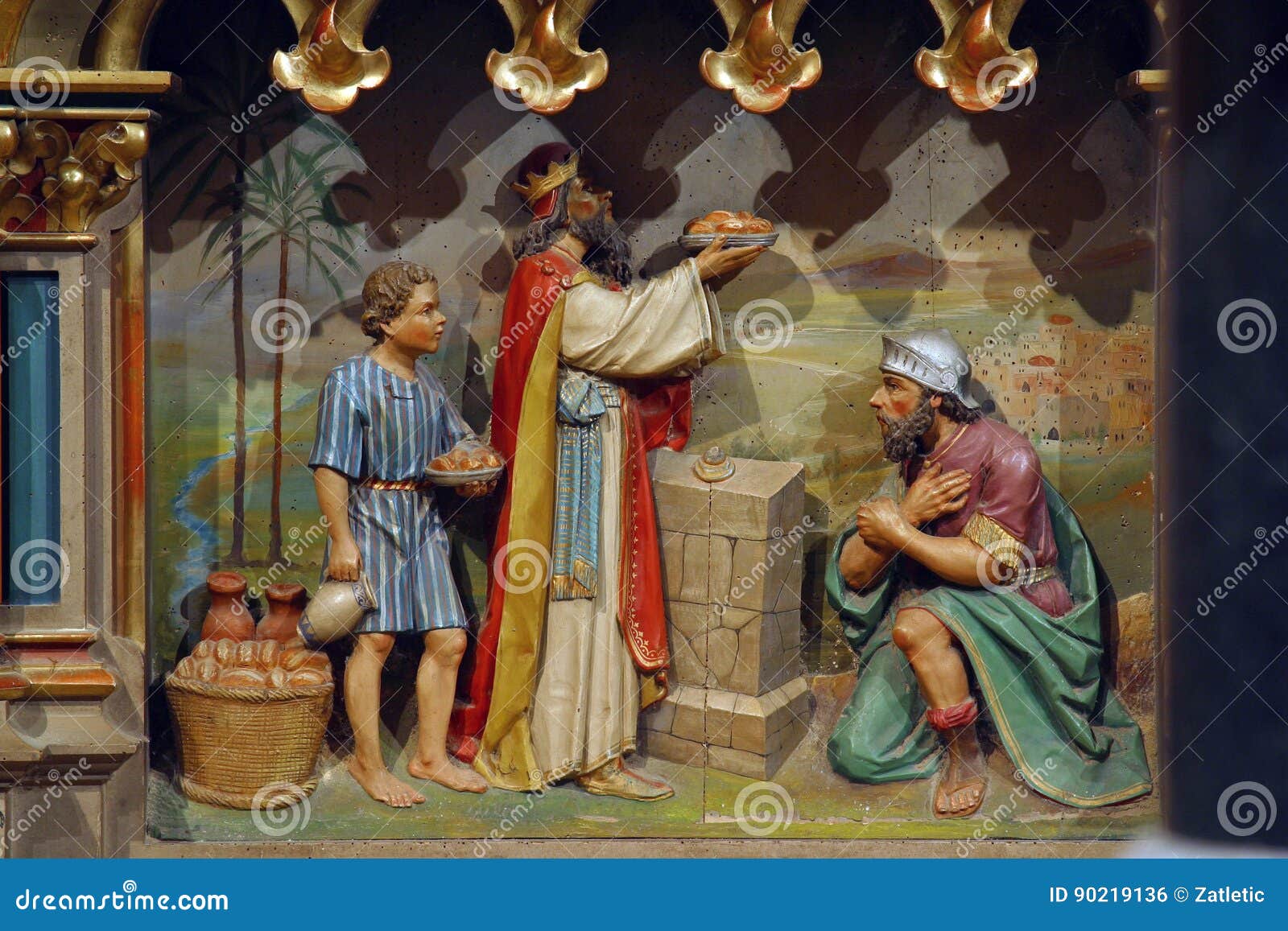
Abraham and Melchizedek stock photo. Image of cathedral - 90219136