Jesus was speaking to the Jews about the Law. “The Law” consisted of two parts: (1) Mosaic and (2) The Word, now wrongly called “The Ten Commandments,” which are the ten sayings (Exod 20:1) of The Word, Jesus.
“Thou shalt” in the Decalogue
(“Ten Sayings”) is the Hebrew word, “yasa” which means come
out or words to that effect.
“Not” is ‘lo in the Hebrew,
meaning never. The Decalogue is “The Word” — Jesus, consisting of
things that should go forth and things that should not.
There are nine “shalt nots” in
the Decalogue, but two of them are one . They are things not ever
to do, thus requiring no work. They are not burdensome because they essentially
are ways to avoid “work.”
The remaining two are (4th)
remembering the Sabbath and (5th) honoring your father and mother. Those
two sayings are not work; remembering and honoring are cognitive — the
way you think.
The New Testament makes a
difference between the types of work: ergo for physical work and katergazomai
for cognitive work (as in “work out your salvation;” Phil 2:12).
Therefore, the Decalogue, “The
Ten Words of God,” are eight things you are not to do and two things to think
about while not working: (1) Remember God resting and rest accordingly, and (2)
honor your parents for bringing you forth. Those ten things should be easy to
do but most people forger the Sabbath and dishonor their parents.
The “Law,” therefore should be easy to do, should they not? because you are to do nothing. That is grace; for doing nothing you are rewarded, are you not? That should provide you with a different outlook on the Law. Jesus did not find them burdensome, so He would not do away with the Law, and said so:
Think not that I AM come to destroy the
law, or the prophets: I am not come to destroy, but to fulfil. For verily I say
unto you, “Till heaven and earth pass, one jot or one tittle shall in no wise
pass from the law, till all be fulfilled.
Whosoever therefore shall break one of these least commandments, and shall teach men so, he shall be called the least in the kingdom of heaven: but whosoever shall do and teach them, the same shall be called great in the kingdom of heaven.” (Mat 5:17-19)
Jesus begins with “I AM come.” Who
is the “Great I AM”? Father God. God Himself had come in the flesh. Who wrote
the Law? “I AM” (Yahweh). Jesus was implying that He is God, and it was
by His “finger” that it was written (Exod 31:18).
Jesus had a “finger” before He
came. God is characterized by the Hebrew letter Yod. The yod is an arm
with hands and fingers. Jesus is the Yod of God, and His “finger” was
the “pen of quick writing” of ancient literature.
Jesus existed before He revealed
Himself to mankind. In other words, Jesus was always with us (the meaning of “Immanuel”)
but the bodily image of Him was usually never seen. It’s not that Jesus was not
with us, for He was, but the Jews and especially the pagans could not see Him because
their eyes were dim to esoteric things.
John wrote that Jesus is “The
Word” (John 1:1-14). He was there from the beginning but only righteous people
and the humbled (at times) could see Him.
Jesus was not another Being, but God
revealed, to wit:
Whosoever commits sin transgresses also the Law: for sin is the transgression of the Law. And you know that He was manifested to take away our sins; and in Him is no sin. (1 John 3:4-5)
“He” in that passage is “the Father” (1
John 1:1). The “Father” (Yahweh) was revealed as a real
substance. It is not “God and Jesus” but “God is Jesus and Jesus is God.” Jesus
is God revealed to mankind to “take away our sins,” as it says.
The “Name” in the Decalogue
is “Jesus.” We are not to take that Name in vain, meaning with frivolity or
triviality.
The Name, Jesus, is in the Law.
Jesus is Hashem — “The Name of God” in the Hebrew. The Jews still do not
understand; they are not to take the Name, Jesus, vainly. The Ten Commandments
hang on Jesus as the love of God. They are ten ways to love God, be Him in Body,
Spirit, or Holy Ghost.
The Decalogue is the “Law”
and Jesus, the Yod of God wrote it. He did not come to destroy the Law
but to fulfil it. The letter Yod is the Law and Jesus is the Father, Yod,
revealed. Hence, Jesus is the “letter” of the Law.
The “Law” in the Decalogue
are easy things, and Jesus would not remove one jot or tittle.
A “jot” is the Greek letter iota.
The Hebrew equivalent is the letter yod. Jesus would not take the Yod
from those Ten Sayings. Yod is said “Ya” as in “Yahweh.”
Jesus would not remove God from any of those Ten Words.
Yod was said to have begun
with a dot that spread until now it is the figure of the arm with hand. In a
sense, “the pen of quick writing” with which Jesus wrote was the Power of the Yod
which Power is the Hebrew letter aleph, representing the creative
Power of “Father,” Yod.
Think of the letter yod as
a dot as in dot-matrix printing; all letters and words, like jots or dots, are
in each letter and word of the Law. The Ten Words were written with the letter yod
in its simplest form. Take away any dots, then the word would be dimmed. Take
away more dots and the words would not exist.
Many have seen dot-matrix printing
where the printer missed dots; words there don’t make sense; and take God (The “Yod”)
out of the Ten Sayings, and then they do not make sense.
Now for the word “tittle.” Jesus
said, “It is easier for heaven and earth to pass, than one tittle of the law to
fail” (Luke 16:17). “Tittle” in the Greek version is “keraia.” Keraia
are “little horns” or “extremities” of the Hebrew letters.
Each letter points toward the
next in words, usually in three characters in verb, object, and subject order. The
aleph points toward the bet and the bet point toward the gimmel.
God was first manifested as the Power of the “ox” (Aleph), then the “House”
(Bet) or Flesh of God, and then the Holy Ghost signified by the letter gimmel.
The three-in-one letters are the ‘Godhead.’
Take away any one, then the letter of the Law would not be the whole Law.
The crucifixion, for three days,
took the Aleph and the Gimmel from the Bet, and they went
their separate ways. Jesus lost His Virtue (the Aleph) in saving mankind
and then gave up the Holy Ghost (the Gimmel).
As Jesus died on the Cross, He
said, “It is finished” (John 19:30). Those words referred to the jots and
tittles: ““Till heaven and earth pass, one jot or one tittle shall in no wise
pass from the law, till all be fulfilled.” The crucifixion made the tittles
meaningless — no longer did the points of the letters point to the next letter but
were in disarray. The Godhead had been disassembled, and when Jesus was
resurrected, he was “raised” or literally “assembled.”
It seems the word “tittles”
referred both to the Hebrew aleph-bet and the Crucifixion followed by
the Resurrection, so now you should know your jots and tittles and that the
crucifixion fulfilled the Law and the ABCs.
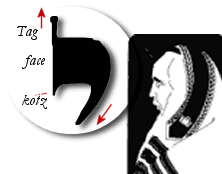
The "tittle" would be the face of the letter yod in this case,

No comments:
Post a Comment