Showing posts with label law. Show all posts

Tuesday, December 2, 2025

THE LAW A HURDLE TO OVERCOME

Commandments and The Law have been problematic for too many people beginning with Adam and his wife. The Law and The Ten Commandments remain obstacles even to modern Christians. Now let’s examine why.

The translations of the Bible are good, but I believe that both the Hebrew and the Greek are the very words of God and that “The Law” (Torah) was written in ancient Hebrew pictographs. Hence, let’s look at theological words through the lenses of ancient Hebrew.

Commandments are things that either must be done or ought not to be done. In the Hebrew, what is termed in English “commandment” is מִצְוָה in the Hebrew. Analyzing each letter at a time, let the meaning of “misva” be investigated going from right to left: mem, tsade, vav, hey.

The letter mem, in this case, is either dynamic or plurality. Mem is actions characterized by the waveform of either blood or water.

Tsade is a hook from which something hangs. It represents the righteousness of God. Misva is to be righteous as God is righteous. It is a countenance, not an obligation.

The letter vav (waw) is some sort of connection between the seen and unseen, or even God and man. It is entanglement; when Christians say “in Christ” which is the love of God from whom any other creature cannot separate us (Rom 8:39).

“Christ” in the Hebrew is the Messiah. Hence, the vav represents the Messiah, Jesus (Yeshua). “In Christ” is entanglement, having the same countenance as Christ Jesus. Noting that the Messiah is Jesus, commandments still pointed toward Jesus because of the letter vav connecting the present to the future. Thus, Jesus is The Law and thus, Jesus came to fulfil The Law (Mat 5:17). The vav in misra points toward The Law not being complete but would be sometime in the future.

Jesus said about The Law of love, “these two commandments hang all The Law and the prophets” (Mat 22:40). The two commandments are the love of God and the love of fellow men. Love is the connector (vav) in misva. Connect what to what?

(It is to be noted that “love” is not emotional but an attitude of respect.)

The letter hey is revelation from God, obviously from God “breathing” on His people from scripture, or according to Paul: 

…the holy scriptures, which are able to make you wise unto salvation through faith which is in Christ Jesus. All scripture (The Word) is given by inspiration (hey) of God, and is profitable for doctrine (lamed), for reproof, for correction (zayin), for instruction in righteousness (tsade) that the man of God may be perfect (tav), thoroughly furnished unto all good works (yod). (1 Tim 3:15-17) 

Inspiration is “God-breathed,” represented by the Hebrew letter hey. Hence God breaths wisdom via Holy Scripture, so it is wise, not obligation, to follow The Law. Inspiration is God breathing truth into your minds, and then it is up to us to either adhere to it or to ignore it. That action is by the conscience.

Adam found that out very quicky by not following The Law and choosing, not the Wisdom Tree, but the Tree of Knowledge.

Knowledge is associated with wisdom simply by this; “Prove all things and hold onto what is good” (1 Thes 5:1). The Law is basically a test for wisdom; for example, it is not wise to have other gods nor to offend your fellow men.

Holding is how The Law hangs on love. Paul was simply acknowledging the Hebrew letter tsade — to hang. That Jesus was hanged on a tree (Acts 5:30) points toward the crucifixion; that Jesus loved us so much that He died for us. The letter tsade may very well imply the Cross as the ultimate act of love. The Cross was the fulfillment of the Law for Jesus said, “It is finished” (John 19:30). The crucifixion of Jesus was the completion of the Law by ultimate love from God Himself.

Tsade also validates that The Law hangs on love (Mat 22:40), and that love is revealed by God’s sacrifice of Himself in which Jesus was the perfect sacrifice (Heb 10:1).

Hence “commandments” are not so much as actions but “ten gratitude’s” (good attitudes) for God’s sacrifice of Himself rather than us.

The commandments were The Law (Torah). However, what was The Lord’s Law (Exod 13:9; tora), spelled תּוֹרָה.

First comes the letter tav — the cross, the mark of God and either the Covenant of Grace and/or completion. “It is finished,” and by that Jesus meant that the Cross and His death were the fulfillment of The Law (tora).

Secondly comes the letter vav. That connects the past with the present, thus connecting the old covenant with the new — the two testaments as one legal document. It also identifies the Messiah who was to come.

Thirdly comes the letter resh. It represents both the beginning and the Head of the Godhead. As a pictograph of a man, it identifies that the Head of the Godhead — The Holy Trinity — is a man. The tora pointed toward God as “The Son of Man” (Mat 8:2). Jesus is not the offspring of God (son) but the gens of Yahweh. He is the “vessel” in which the Virtue of God resides and has the authority of the Father just as the letter resh indicates.

Lastly comes the letter hey at the end. At the end, it signifies completion — the Presence of God. Pointed toward by the letter resh indicates that the “Son of Man,” even in The Old Testament prophecies, points to The Presence of God in the form of a Divine Man.

Tora is not just the beginning Law but points to Jesus as the fulfillment of the Law. 

The Hebrew Torah is the foundational text of Judaism, referring to the first five books of the Hebrew Bible: Genesis, Exodus, Leviticus, Numbers, and Deuteronomy. In a broader sense, it can also refer to the entire Hebrew Bible or the whole tradition of Judaism, including both written and oral law. These five books, also known as the Pentateuch or Five Books of Moses, contain narratives and laws, with the laws outlining how God wants Jews to live.  (AI Overview) 

With that explanation, Jesus (Yeshua) is the fulfillment of the whole Law of the Hebrews.

Jews put much emphasis on the laws of both God and Moses, but fail to understand that the fulfillment of The Law is love. Indeed the “Ten Misra’s” are four ways to love God and six ways to love others. In other words, The Ten Misra’s are “The Greatest Commandment” of which Jesus spoke, or ways to love. The Ten Misra’s was always the Way to “salvation” (Yesua), but the Jews never understood that. It is not that them fulfilling The Ten Commandments was so bad, but that Jesus was the only one who could fulfill them as hard as the Pharisees made them try.

Nobody, not even the Chief Pharisee Priest, could fulfill the Law, but Jesus did just that. It is not that they were mean-spirited, but that they failed to breath in any inspiration that God had breathed out.

The Jewish problem was that they would fulfill the Law despite Jesus there for that very purpose. The solution to the Jewish problem is never holocaust but Yesua.


Thursday, May 22, 2025

THE FINISH: THE JOTS AND TITTLES FULFILLED

Jesus was speaking to the Jews about the Law. “The Law” consisted of two parts: (1) Mosaic and (2) The Word, now wrongly called “The Ten Commandments,” which are the ten sayings (Exod 20:1) of The Word, Jesus.

“Thou shalt” in the Decalogue (“Ten Sayings”) is the Hebrew word, “yasa” which means come out or words to that effect.

“Not” is ‘lo in the Hebrew, meaning never. The Decalogue is “The Word” — Jesus, consisting of things that should go forth and things that should not.

There are nine “shalt nots” in the Decalogue, but two of them are one . They are things not ever to do, thus requiring no work. They are not burdensome because they essentially are ways to avoid “work.”

The remaining two are (4th) remembering the Sabbath and (5th) honoring your father and mother. Those two sayings are not work; remembering and honoring are cognitive — the way you think.

The New Testament makes a difference between the types of work: ergo for physical work and katergazomai for cognitive work (as in “work out your salvation;” Phil 2:12).

Therefore, the Decalogue, “The Ten Words of God,” are eight things you are not to do and two things to think about while not working: (1) Remember God resting and rest accordingly, and (2) honor your parents for bringing you forth. Those ten things should be easy to do but most people forger the Sabbath and dishonor their parents.

The “Law,” therefore should be easy to do, should they not? because you are to do nothing. That is grace; for doing nothing you are rewarded, are you not? That should provide you with a different outlook on the Law. Jesus did not find them burdensome, so He would not do away with the Law, and said so: 

Think not that I AM come to destroy the law, or the prophets: I am not come to destroy, but to fulfil. For verily I say unto you, “Till heaven and earth pass, one jot or one tittle shall in no wise pass from the law, till all be fulfilled.

Whosoever therefore shall break one of these least commandments, and shall teach men so, he shall be called the least in the kingdom of heaven: but whosoever shall do and teach them, the same shall be called great in the kingdom of heaven.” (Mat 5:17-19) 

Jesus begins with “I AM come.” Who is the “Great I AM”? Father God. God Himself had come in the flesh. Who wrote the Law? “I AM” (Yahweh). Jesus was implying that He is God, and it was by His “finger” that it was written (Exod 31:18).

Jesus had a “finger” before He came. God is characterized by the Hebrew letter Yod. The yod is an arm with hands and fingers. Jesus is the Yod of God, and His “finger” was the “pen of quick writing” of ancient literature.

Jesus existed before He revealed Himself to mankind. In other words, Jesus was always with us (the meaning of “Immanuel”) but the bodily image of Him was usually never seen. It’s not that Jesus was not with us, for He was, but the Jews and especially the pagans could not see Him because their eyes were dim to esoteric things.

John wrote that Jesus is “The Word” (John 1:1-14). He was there from the beginning but only righteous people and the humbled (at times) could see Him.

Jesus was not another Being, but God revealed, to wit:

Whosoever commits sin transgresses also the Law: for sin is the transgression of the Law. And you know that He was manifested to take away our sins; and in Him is no sin. (1 John 3:4-5)

“He” in that passage is “the Father” (1 John 1:1). The “Father” (Yahweh) was revealed as a real substance. It is not “God and Jesus” but “God is Jesus and Jesus is God.” Jesus is God revealed to mankind to “take away our sins,” as it says.

The “Name” in the Decalogue is “Jesus.” We are not to take that Name in vain, meaning with frivolity or triviality.

The Name, Jesus, is in the Law. Jesus is Hashem — “The Name of God” in the Hebrew. The Jews still do not understand; they are not to take the Name, Jesus, vainly. The Ten Commandments hang on Jesus as the love of God. They are ten ways to love God, be Him in Body, Spirit, or Holy Ghost.

The Decalogue is the “Law” and Jesus, the Yod of God wrote it. He did not come to destroy the Law but to fulfil it. The letter Yod is the Law and Jesus is the Father, Yod, revealed. Hence, Jesus is the “letter” of the Law.

The “Law” in the Decalogue are easy things, and Jesus would not remove one jot or tittle.

A “jot” is the Greek letter iota. The Hebrew equivalent is the letter yod. Jesus would not take the Yod from those Ten Sayings. Yod is said “Ya” as in “Yahweh.” Jesus would not remove God from any of those Ten Words.

Yod was said to have begun with a dot that spread until now it is the figure of the arm with hand. In a sense, “the pen of quick writing” with which Jesus wrote was the Power of the Yod which Power is the Hebrew letter aleph, representing the creative Power of “Father,” Yod.

Think of the letter yod as a dot as in dot-matrix printing; all letters and words, like jots or dots, are in each letter and word of the Law. The Ten Words were written with the letter yod in its simplest form. Take away any dots, then the word would be dimmed. Take away more dots and the words would not exist.

Many have seen dot-matrix printing where the printer missed dots; words there don’t make sense; and take God (The “Yod”) out of the Ten Sayings, and then they do not make sense.

Now for the word “tittle.” Jesus said, “It is easier for heaven and earth to pass, than one tittle of the law to fail” (Luke 16:17). “Tittle” in the Greek version is “keraia.” Keraia are “little horns” or “extremities” of the Hebrew letters.

Each letter points toward the next in words, usually in three characters in verb, object, and subject order. The aleph points toward the bet and the bet point toward the gimmel. God was first manifested as the Power of the “ox” (Aleph), then the “House” (Bet) or Flesh of God, and then  the Holy Ghost signified by the letter gimmel.

The three-in-one letters are the ‘Godhead.’ Take away any one, then the letter of the Law would not be the whole Law.

The crucifixion, for three days, took the Aleph and the Gimmel from the Bet, and they went their separate ways. Jesus lost His Virtue (the Aleph) in saving mankind and then gave up the Holy Ghost (the Gimmel).

As Jesus died on the Cross, He said, “It is finished” (John 19:30). Those words referred to the jots and tittles: ““Till heaven and earth pass, one jot or one tittle shall in no wise pass from the law, till all be fulfilled.” The crucifixion made the tittles meaningless — no longer did the points of the letters point to the next letter but were in disarray. The Godhead had been disassembled, and when Jesus was resurrected, he was “raised” or literally “assembled.”

It seems the word “tittles” referred both to the Hebrew aleph-bet and the Crucifixion followed by the Resurrection, so now you should know your jots and tittles and that the crucifixion fulfilled the Law and the ABCs.


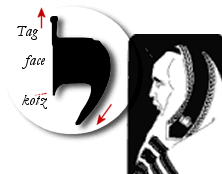
The "tittle" would be the face of the letter yod in this case,


Friday, June 21, 2024

FOUR HUNDRED YEARS OF SILENCE

 The Word of God ceased speaking for four-hundred years. Only the prophets and patriarchs had heard the Word; to everyone else, the Word had remained silent. The prophets were the “mouthpieces” of God; their words had been the inspired Word of God: 

All scripture is given by inspiration of God, and is profitable for doctrine, for reproof, for correction, for instruction in righteousness: that the man of God may be perfect, thoroughly furnished unto all good works. (1 Tim 3:16-17)

 The gospels and the Pauline letters are not “scripture.” That does not mean that they were not inspired by God, for they were, but that Paul was writing to Timothy about the Old Testament wherein the invisible Word spoke to the prophets who in turn spoke to the Israelites.

Many fail to understand the concept of the “Word.” The Word is the Truth whether it is written or not. The best definition of the “Word” is that it is the “Thoughts” of God before His Face was exposed to speak those divine Thoughts. Rather than the prophets, Jesus came unto the world to Be the Mouthpiece of God. Why is that? Were the prophets no longer inspired? We shall see.

Jesus, before He assumed form like a man, revealed Himself as the “Angel of God.” Of all people, Hagar the Egyptian servant of Sarai was the first one who heard the “Angel of the Lord” called that. Before, it was the “Lord God,” the “Voice” and “God said.”

God, in the beginning, did not necessarily speak audibly but literally “uttered” — He sent forth a wave of some sort, whether it was a sound wave or any other dynamic. Based on the concept that it was “good” (Gen 1:31), then it was Virtue (Dynamis) — the same Dynamic that Jesus used to make the sick and infirm whole again.

The Word was making the whole Creation, and it was not likely by speech (sound) alone. God ushered forth all things by His utterance… some great Wave that He sent forth. That “Dynamic” whatever it was, was the “Word” of God. The first time God “spoke” was to make the whole cosmos.

That is what John meant when he wrote: 

In the beginning was the Word, and the Word was with God, and the Word was God. The same was in the beginning with God. All things were made by him; and without him was not any thing made that was made. (John 1:1-3)

 The “Word” was the utterances of God, not necessarily in speech, but in Power that God emanated.

So, when it is said that God was silent for 400 years, He no longer spoke, nor did He act upon the cosmos — at least in our world. In a sense, in the four-hundred years before Christ, mankind was left on his own with no intervention from God. That coincided with the Hellenistic period of Judah; when the Hebrews became “Greeks” inwardly, and sometimes even outwardly, as some Jews somehow concealed their circumcisions to perform in the Olympiad with the Greeks.

By the time of Jesus, the Hebrews were essentially Greeks in nature and spirit.

Micah even spoke of the silence before the “four-hundred years of silence” began with the last prophet Malachi. The Book of Micah was written in the mid 700’s BC. God had inspired him to issue a warning, and the warning came to fruition in a little over 400 years before Christ.

The following was what the Word told Micah to write as the “world” began to fall apart: 

Thus said the Lord concerning the prophets that make my people err, that bite with their teeth, and cry, “Peace;” and he that puts not into their mouths, they even prepare war against Him. Therefore, night shall be unto you, that you shall not have a vision; and it shall be dark unto you, that you shall not divine; and the Sun shall go down over the prophets, and the day shall be dark over them. (Micah 3:5-6)

 The inspired “Word” would become “dark” unto the prophets, “Said the Lord;” the Word of God was speaking but not necessarily audibly. He was perhaps inspiring Micah with His Thoughts.

The Word said to Micah, “Behold, the Lord comes forth out of His place, and will come down, and tread upon the high places of the Earth” (Micah 1:3). The Lord God warned Micah that He would come in the flesh, and that was what John was writing about. Because the prophets were no longer inspired by God, but another “god,” they no longer would have visions about the One True God. God gave a warning, and sure enough, for four-hundred years before Christ came, God left mankind to their own devices, and they did little else but war with those to whom they paid tribute.

God let the Greeks have their way with them whereas in the time of Malachi, the Babylonians had their way with them. Jerusalem first became the “harlot Babylon” and then fornicated with the Greeks.  In both cases, they fornicated against God and their natures changed to be like the pagans.

Fast forward to this age. The Church of God that was to endure forever; it is fornicating with the world. No longer do Christians hear and obey the Word of God; thinking that the Word must no longer be heeded. Many Christians believe the Word of God to be “legalism,” but it is not. The “finger of God” — Jesus — wrote the Word on stone for perpetuity. As it turns out the Commandments are not “commandments” at all but standards for a long-life. They are things that Christians are to do to please God and things we ought not to do to others to please God. Rather than Commandments, they are God’s Will for the heirs to His Estate.

Just as the day would be darkness over the prophets, this age is darkness over the Church. The prophets were “playing” the role of prophets and now Christians are “acting” the role of Christians, all the while neglecting the Word of God that was written on stone.

I believe the Ten Commandments were the first use of an alphabet to make words to transmit ideas. I believe that the Words on those two tablets was “Jesus” in stone, not His Person, but His Dynamic that was put onto the first “Bible.” The tablets were in a sense, the Image of God.

They were “Bible” in the sense that the stone was the medium on which the Word was written. By denying the validity of the Ten Commandments is taking the Lord’s Name in vain — that Jesus did not write them!

There was a pall over Judea and there is now a pall over the Church. A “pall” is a dark covering over a casket. Too many are pall bearers, and the dead is the whole Church. It is not the Dynamic of God that is perhaps so active but false prophets.

Casket Pall

Wednesday, March 20, 2024

ALMIGHTY GOD PETERED-OUT

Pilate, who authorized that Jesus be crucified, despite knowing his innocence, did so to prevent the wrath of the Jews against the Roman government. Jesus said to Pilate, who seemed sorrowful for what he was about to do, “You would have no power over Me if it were not given to you from above. Therefore, the one who handed Me over to you is guilty of a greater sin” (John 19:11).

That “one” could be Judas or someone else. Judas did hand Jesus over, but not to Pontius Pilate. Caiphas handed Jesus over directly to Pilate to do the bloody thing. It may have not been Caiaphas, the chief priest, who did so literally, but he was the responsible party. Scripture identifies Caiaphas as the “one” who handed Him over to be crucified:

Jesus said to His disciples, “You know, the Passover is two days away—and the Son of Man will be handed over to be crucified. Then the chief priests and the elders of the people assembled in the palace of the high priest, whose name was Caiaphas, and they schemed to arrest Jesus secretly and kill him. “But not during the festival,” they said, “or there may be a riot among the people.” (Mat 26:2-5)

The festival is the feast of unleavened bread. The festival lasts for seven days of which in the last day no work could be done (Lev 23:8). It was to be a “convocation,” and “This day shall be unto you for a memorial, and you shall keep it a feast to the LORD; throughout your generations you shall keep it a feast by an ordinance forever” (Exod 12:14). A ‘convocation’ is when the people assembled, in this case, to glorify God who had delivered them.

When the chief priests and the elders assembled, that was the Passover convocation. The convocation of the Jews was not stupid, for they said, “or their may be a riot among the people.

Jesus, indeed, was killed before the Passover Sabbath began, on Friday, April 3, AD 33. If Jesus had been killed on the Passover Sabbath, supposed to be a day of rest, the elders and chief priests knew there would be a riot. They were adamant about not working on the Sabbath and the Passover Sabbath was a festival. It could be that killing Jesus, which was work, could not be done on the day of rest, and especially during the Passover festival.

It is to be noted that Jesus was the Passover ‘Lamb’ of God. He would need to be killed in preparation for the Sabbath. Jesus, as the sacrificial Lamb of God was legally killed, according to Mosaic Law. He was killed at a legal time but not for a righteous cause.

The sacrificial lambs were always a vicarious sacrifice to God, but here they were really killing God in the form of a sacrificial man. Note that they did not kill God, but they did sacrifice His perfect flesh, just as the sacrificial lambs were to be the firstborn, perfect, and without blemish.

It is obvious that the people did bring their sacrifice to the altar of the Sacred Cross, but unknown to them all, it was God making the sacrifice Himself because it was His own flesh that was the sacrifice. No more vicarious sacrifices would do; it had to be God Himself.

Many think that it was not God that suffered on the Cross, but His Son. We think of the sacrifice as His Son; and  Jesus was the ‘Son’ in a sense — genetically so — but within that flesh was the very Substance of God.

However, God did not die that day. If God had died, then there would be no salvation. God did suffer death, but that was the flesh. God took on flesh so that He could feel our pain. His agony was not so much the pain that He endured, but that His creatures were such great sinners that He must suffer death so that they need not!

The Holy Ghost left Jesus as He died. Jesus lost His ‘Virtue’ (dynamis in the Greek). God Himself, in a spiritual sense, died that day, losing His Dynamics. To put it another way, God healed the world by losing immense Virtue. He died because for a time, He spent His Almightiness to save His Creatures, then like in the beginning, after generating Adam, God rested on the Sabbath Day!

God is not dead; He never was! To put it mildly, and Peter would understand, in modern vernacular, God was Petered-out; just as Peter denied Him thrice — once for the Father, once for the Son, and Once for the Holy Ghost; people still deny His Substance left behind — the Holy Spirit.


GOD RESTING AFTER THE CREATION

Monday, March 18, 2024

ABOUT TRANSFERENCE AND EMPATHY

The Greatest Commandment, Jesus answered is two:

You shall love the Lord thy God with all your heart, and with all your soul, and with all your mind. This is the first and great commandment. And the second is like unto it, You shall love your neighbor as yourself. On these two commandments hang all the law and the prophets. (Mat 25:37-40)

 First off, love is the Law. The Law, specifically the Ten Commandments, hang on those two commandments. (One through four of the ten are about loving God while five through ten are about loving others.)

That passage reveals that the Law of God remains in effect. For those who fail to understand the Law, Jesus operationalized it for them; it is to love Him and to love others — your neighbors — or other citizens of the world. How is anyone able to do commands; not by works, but by the concept of lovingkindness — agape-type love… goodwill.

The will is a mental faculty. Mental work is more ergonomic than manual tasks. The work of loving is not what a person does but how he or she thinks. The heaviest work that Christians are to do is to control their thoughts.

The Greatest Commandment was numbered “first” and “second” by Jesus. Jesus was asked which one. He answered with two. Was He confused? Could He count? No, He was not, and yes He could count! He was making a point. Check this out from the parable of the sheep and goats:

Jesus said, “The King will reply, ‘Truly I tell you, whatever you did for one of the least of these brothers and sisters of Mine, you did for Me.’” (Mat 25:40)

Jesus told them what they had done for Him: 

 “For I was hungry and you gave Me something to eat, I was thirsty and you gave Me something to drink, I was a stranger and you invited Me in, I needed clothes and you clothed me, I was sick and you looked after Me, I was in prison and you came to visit Me.’” (Mat 25:35-36)

 They strangely denied doing those things for Jesus! They in fact had done none of those things directly for Jesus.

In the key verse above (verse 40), Jesus explained to them how that was done, albeit even unwittingly. Many of them had done those things for other Christians who Jesus called His “brothers and sisters.” Note that it was the family of Jesus for whom they did things; not the family of the Devil — the lost sheep, so to speak. Not that helping the lost is to be discouraged but that Jesus was encouraging Christians to take care of their own. Their hearts had been tenderized by becoming new creatures in Christ.

In psychological terms, doing good things for others is prosocial behavior — empathy. Jesus was born to serve mankind. Like any good master, Jesus mastered that behavior. To serve others, He enlisted others to serve with Him. By serving brothers and sisters of Jesus that is serving others because Christians serve with Jesus. It takes the load off the Master when the servant assists!

Jesus, in the key verse, revealed how two commands are one: His brethren love Him by loving others. They are empathetic for Jesus by having empathy for others. However, there must be right reasons — you must serve others for the glory of God and not for self-glorification. You must be empathetic, not guilty of transference… by exalting yourselves by helping others. Those, like the rich ruler of Luke chapter eighteen who had done good things, not for the glory of God, but because it was the humane thing to do. It was not done to elevate God but to elevate others, in effect, the ruler was magnifying himself for the things that he had done.

Note from the key verse that empathy is directional. Jesus can be loved by doing good for others, transferring the glory to Him, but doing good things for Jesus without doing so for others is futile.

Many otherwise wicked people often do good things. Many renowned philanthropists have done good things for needy people. However, who gets their names on the buildings and statues? Not Jesus for sure. It is them that get the glory. Recognition is getting the reward here and now. Good things must be done without fanfare and in secrecy to magnify God, to wit: 

Take heed that you do not your alms before men, to be seen of them: otherwise, you have no reward of your Father which is in heaven. Therefore, when thou do your alms, do not sound a trumpet before yourself, as the hypocrites do in the synagogues and in the streets, that they may have glory of men. Verily I say unto you, “They have their reward.” But when you do alms, let not your left hand know what your right hand does. (Mat 6:1-3)

 Doing things for recognition is transference by helping others to help you; it exalts yourselves. Even thinking, Behold the good that I have done, is transference.

Doing those good things in secret is genuine empathy. ‘Empathy’ is feeling the pain and distress of others, and doing things for others that you would want others to do for you. It is the ‘Golden Rule’ in operation. It is sorrow for others because you know their sorrow.

The rich ruler had done good things and reviewed how he had honored the last tenets of the Ten Commandments. However, what had he done for God? He never mentioned that at all, so the man was not magnifying God but glorifying himself.

The way to feed those who are hungry and unclothed, and so forth, is to do so for the glory of God.

Charity should be an unknown work. Who is not human? Have we all not done things that are good to make a name for ourselves? It should not be so hard work to keep our almsgiving and such a secret.

One church that I attended had a donor pay off the mortgage. His or her name remain to this day unknown. Nobody got the glory except Jesus. Jesus did not have His valor stolen.

Another church received a large grant from the estate of a person who was identified — a person known to the church. That person, and maybe even the family, may get the glory.

In all things we do, it should not be broadcast.

For instance, a person I know donated $500 to his church without fanfare. The preacher asked the congregation to be generous, naming both himself and the other person. Both got their reward right then in the form of recognition. It was them that made a name for themselves, leaving out Jesus who laid it on the man’s heart.

In summary, there is one Commandment — to love — and Jesus made it clear that true love for Him can be demonstrated by loving others. Therefore, it is not so much two commandments but one in two manners of accomplishing the same objective, and that is to magnify Jesus.

(picture credit; Social Media Ministries)


Saturday, January 20, 2024

ROME PATTERNED AFTER GOD'S KINGDOM


The parable of the workers was about nothing else but the Kingdom of God (Mat 20:1). There, Christ is King and He revealed that it is His Kingdom to do as He sees fit to do. He was revealing to the crowd that He would be the judge of who gets what and how long they must endure to obtain the Kingdom. He would be the ‘Dictator’ in a manner of speaking.

Of course, in the parable, Jesus was using an estate to make His point. It does so very eloquently because the Kingdom of His is in heaven — in another realm (John 18:36).

His Estate would be very much like the householder’s in the parable. Most people have not noticed but the Roman Kingdom became much like the Kingdom of Heaven in that the latter came first. Jesus even compared His Kingdom to the estate of a certain householder (Mat 20:1). He had one in mind, it seems. That householder in the Greek was oikodespotes, meaning “head of the family.” In the end, the householder treated those that he hired as he would his family; they all received the same pay without regard to which came first. (He ignored the Law of Primogeniture, the natural law.)

Now, rather than considering who worked most, think of the workers as family. By the Law of Primogeniture, the one who came first would get the entire estate. Throughout history, the Hebrews mostly determined an inheritance by which son came first. For example, Esaw came first, but eventually, Jacob stole his birthright that belonged to Esaw by the Law of Primogeniture (Gen 25:33).

However, the Romans did not have that law. Usually, the estate was given to each child equally. Who came first in Roman  Law was not of concern nor even if the person was biological family or not.

As it turned out, Jacob, then called ‘Israel,’ divided the birthright that he stole from Esaw. Each of his ‘sons,’ even his two adopted sons, sons of Joseph, received nearly an equal portion. As it turned out, all but Judah and Benjamin had their share squandered and the other ten heirs disappeared to history. They sold their birthrights by sinning.

Jesus likened heaven to a householder. That householder could have been Caesar since God patterned the Roman Empire after Israel. How so? Throughout history, according to Livy’s History of Rome (or Ab Urbe Condita). The Roman Empire, as it evolved through time, was ruled by a series of kings, councils, and dictators until it had one ‘King of kings’ — Augustus Caesar who was a dictator turned emperor.

The word ‘Caesar’ comes from the Latin, meaning ‘head of hair.’ (Caesar Family History). It began as a family name, and soon all Caesar’s afterward adopted that name so often that it became a title for about any head of an empire. The titles Tzar, Kaiser, and Czar; among others, came from that family name. Most leaders prefer to be called a ‘Caesar’ than a dictator for obvious reasons!

The first known ‘Caesar’ was Sextus Julius Caesar of the house of Julii — the progenitor of the non-genetic house of Caesar.

Tiberius was adopted, so genetically, he was not Julian nor did he deserve the cognomen (nickname) that reflected their origin.

For instance, Tiberius Caesar was adopted, but by adoption, he was still a Caesar. The Kingdom of Heaven uses that same cognomen. God — the heavenly ‘Caesar’ (King of kings) “Having predestinated us unto the adoption of children by Jesus Christ to Himself, according to the good pleasure of his will, to the praise of the glory of His grace, wherein He has made us accepted in the beloved” (Ephes 1:4-5).

That is by the same process as Tiberius Julius Caesar Augustus was adopted by Gaius Julius Caesar Augustus (Octavian Caesar). Tiberius was the step-son of the ‘householder’ Augustus Caesar and carried on the family name although it was not his genetic identity, or family.

That was no coincidence. God created empires for His specific reasons. He had created the Assyrian Empire to cleanse the genetics of Jacob’s rebellious sons, and the Babylonians to purify the genetics of the sons of Judah and Benjamin. After those chores were accomplished, God then created the Hellenistic Empire (Greece) to make the Jews sorry they were ever born!

By the time of the Roman Empire, the Davidian household, from the genes of Abraham, had been shattered, leaving only an ethnarchy — Judea. The Jewish Empire had once been the great Davidian Empire, and only Jews — the ethnarch Hebrews — had disappeared from history. (Ethnarch points toward genetic Jewry.)

The final straw was when God created the Herodian Empire to bring the Jews to their knees. Although he was ‘Herod the Great’ because of his accomplishments, he made a name for himself by trying to finally terminate even the thoughts of a Davidian Kingdom’ then along came Jesus, the ‘son of David’ and heir to the throne of David.

Jesus was born King of kings. He was the supernatural born ‘Caesar’ and Judea was His household on Earth.

Just like the early kings of Rome created the Caesarian Dynasty, the early kings of all of Israel created the Davidian Dynasty. David was a ‘Caesar’ as the youngest son of Jesse. That was in the works for centuries, as Paul reminded us, “Esaias said, ‘There shall be a root of Jesse, and He that shall rise to reign over the Gentiles; in Him shall the Gentiles trust” (Rom 15:12).

When Jesse sired his children, the Kingdom of God was established. The Kingdom of Jesus had Jesse as it’s root, or as a ‘Caesar.’  God always uses later sons, as He did with David and Jacob long before him, even Moses rather than Aaron. Plus, God cared little whether they were real or adopted sons, so long as He was their God.

Ancient history reveals that Mose (Moses) may have been the son of the Pharoah, Ahmose. He was the actual son of Amran, but he would have carried the cognomen ‘Mose’ after his adopted father Ahmose.  As a king under Pharoah, Moses would be of Pharoah — “The Great House.” Hence, Moses was not his name but his cognomen.

The point to all this history is that God usually created ‘Houses’ with various ‘householders’ and that the parable was not just about any estate, but the governments that God created; specifically the ‘Householder’ Caesar and his heirs.

To wrap up that thesis, consider the House of Julii when the Herod’s ruled the part of Syria around Jerusalem. Herod was king of Judea and surrounding areas. Other parts of Syria had their kings. All those kings reported to Caesar, who by the time of the end of the Herodians (AD 70) were Vespasian, Titus, and Domitian; each Caesars one after another — the father and his two sons, consecutively.

As Jesus died, a new type of Caesar began to be molded, on the order of the Godhead. As the old way was destroyed (the Temple) an invisible empire took its place. It, however, was made visible. Vespasian and his two sons symbolized the ‘godhead.’

Vespasian was the father general who became the Householder of the Roman Empire. He too was a Caesar of the House of Flavius; it was a new beginning (dynasty), but he too kept the title Caesar.

While Vespasian was in Rome on his throne, his son Titus was in Judea and had the authority of his father. According to tradition, according to Josephus, Titus would have been the right hand (in authority) of Caesar and in the absence of Caesar, Titus would have effectively been Caesar.

The same applies to his son, Domitian. His role was more of a governor of foreign interests. He too, in the absence of Caesar, was Caesar. He too was Caesar’s right hand, so to speak.

After defeating the Jews, Vespasian’s Triumphal March into Rome included himself and both his sons, Titus and Domitian. In effect, they were a ‘godhead’ on the order of the Holy Trinity; them even having the title of Pontifex Maximus which is essentially Lord of lords. As King of kings Vespasian, Titus, and Domitian were Caesar’s that marched in triumph.

Compare that to the Father, Son, and Holy Ghost. Vespasian was the father, Titus the son who appeared in person in Judea, and Domitian who never showed his face there!

Of course, they were not real Caesars, being Flavians, and not real Lord of lords, but God patterned that new House of Flavians, not after dictators, but the Regime of God Himself.

After a major victory, it was usually accompanied by a triumphal march to Rome by whoever the general or leader happened to be. This one time, all three leaders appeared to march in triumph over their enemies, rather than one at a time.

The Flavian Dynasty was a facsimile of the Davidian Dynasty of Jesus. Not only did they have their godhead, but marched in triumph in the manner of Jesus.

After Jesus defeated death, in the company of the once dead man, Lazarus, something very Romanish happened:

On the next day much people that were come to the feast, when they heard that Jesus was coming to Jerusalem, took branches of palm trees, and went forth to meet Him, and cried, “Hosanna: Blessed is the King of Israel that comes in the Name of the Lord” and Jesus, when He had found a young ass, sat thereon; as it is written, “Fear not, daughter of Sion: behold, thy King cometh, sitting on an ass's colt.” (John 12:12-15)

Note who was on that colt and its mother ass? (Mat 21:2). Jesus was on the colt. Nobody was riding the ass, or not? Jesus came in the Name of the Lord.

The Son was riding the colt, but on the mother of the colt, sat God, the Father, it seems. Everyone has come up with geriatrics about how Jesus may have rode on two steeds, but the empty one was surely reserved for the Father, just as Vespasian was in the Triumphal March as well!

Where was the Domitian figure, the Holy Ghost? He needed no steed because of the baptism of John; Jesus and His Ghost rode together as Sons of God in One.

In the process of time, Vespasian and both his sons sat on the throne in Rome. No longer were the two the right hands of their father, but acted as their father, having the authority of Caesar as they became Caesar’s, thus the concept of three-in-one.

That is not to say that God copied His Realm from the Romans, but that he rebuilt Rome according to His Realm!

Whereas the Flavians had just defeated Jerusalem and would make a new life there, the resurrection of Lazarus proved that Jesus would do the same for us.


Wednesday, December 20, 2023

JUST WHO ARE WE?

(continued)

Previously Jesus had been under attack because of His supposed parentage. The Pharisees were hounding him because his mother was six months pregnant and not yet married to Joseph. By Mosaic Law, that made His mother the ‘harlot’ and His father a ‘lawbreaker’ because he did not put her away. Unknown to them, Mary was not a harlot, but was a virgin who had broken no law, and to be crude, no hymen, and the latter was always the ‘token’ that they checked.

Joseph was a righteous man who knew the true Father of Jesus, and as such, Joseph was a good step-father that protected his adopted son as his own, removing Him from the jeopardy of King Herod’s sicarii.

By adoption, Joseph was as much the father of Jesus as Christians are the ‘sons of God’ by adoption.

Adoption is a process. Paul wrote about it, speaking of followers of Christ, “And not only they (the whole creation), but ourselves also, which have the firstfruits of the Spirit, even we ourselves groan within ourselves, waiting for the adoption, to wit, the redemption of our body” (Rom 8:23).

Now consider the birthing process: God cursed Eve, “Unto the woman He said, ‘I will greatly multiply thy sorrow and thy conception; in sorrow thou shalt bring forth children” (Gen 3:16). Sorrow therein is labor, and conception is pregnancy. Hence, rebirth is much like birthing and gestation both of which women were accursed.

Jesus said, “You must be born again” (John 3:7). That should not surprise anyone (“marvel not”) because there is pain in labor and groaning in pregnancy, especially in the delivery.

The same goes for rebirth, according to Paul.

Christians have the firstfruits of the Spirit during their spiritual ‘pregnancy.’

‘Firstfruits’ are “the beginning of the sacrifice” (Strong 2006). Spiritual pregnancy (conception) begins with God sacrificing His “fruits’ in the beginning, just as He did with Mary.

The messenger of the Lord revealed to Mary how Jesus would come about, “The Holy Ghost shall come upon you, and the power of the Highest shall overshadow you: therefore also, that Holy Thing which shall be born of you shall be called the ‘Son of God’” (Luke 1:35).

Those who are born again, are the beginning of holy things; things start with rebirth. God provided to Mary, His ‘Ghost,’ or in the Greek, “pneuma,” or wind. Therefore, Jesus was molded in the same fashion as Adam… hence Jesus is the Last Adam’: “The Lord God formed man of the dust of the ground and breathed into his nostrils the breath of life; and man became a living soul” (Gen 2:7).

Translated ‘nostrils,’ the literal meaning is ‘face,’ or ‘countenance’ (ibid), or archaically, ‘semblance.’ Adam had the ‘Thoughts’ (semblance) of God. Therefore, the Image in which Adam was created was with the Thoughts of God, therefore thinking no evil.  Rebirth would therefore begin with the Thoughts of God in contrast with the thoughts of men. Speaking about the wicked, God said to Isaiah, “For My thoughts are not your thoughts, neither are your ways My ways” (Isa 55:8).

The firstfruits that come from the Spirit of God — the Pneuma — are Thoughts. The apostle Paul understood that, when he “reasoned in the synagogue every sabbath, and persuaded the Jews and the Greeks” (Acts 18:4). Therefore, the beginning of rebirth is not a carnal act but a Spiritual Thought from God, and as it turns out, ‘multiplication’ was not how it is thought to be, but as Adam and his woman were told, “Be fruitful, and multiply, and replenish the earth, and subdue it” (Gen 1:28).

That ‘fruit’ was the Thoughts of God. They were to multiply living souls by the male breathing the Spirit of God onto his mate, giving her the mind of God. It is not the body that is sacrosanct but the soul which is the ‘vessel’ for the Spirit of God that sembles God and resembles Adam as he was before sin. Hence, carnal knowledge — sexual coitus with pregnancy — was the curse and not the Way of God, remembering that God said that our ways are not His Ways. That would pertain to birth and rebirth as well!

Jesus then began to interrogate the Pharisees who had pride in their knowledge of scripture, knowing all the do’s and don’ts. Rather than saying, you fools, Jesus was more tactful, “He answered and said unto them, ‘Have you not read, that He which made them at the beginning made them male and female?” (Mat 19:4).

The question had been about divorce — putting away one’s wife (Mat 19:3), not for one specific cause, but for “every cause.” In other words, should a man look for just any cause to divorce his wife. Any sin, perhaps, would suffice to them. Therefore, since “all have sinned and come short of the glory of God” (Rom 3:23), then just wait until the woman comes short even one time and voila!

It is now convenient to identify ‘glory.’ Glorious is the Image of God and Adam was made in that same Image. First off, it was not his flesh that was the Image of God but his ‘Selem’ (Hebrew), the ‘Shadow’ or “Phantom” of God (ibid). The flesh was nothing — nakedness — to God; it was the living soul that God planted in the Garden; the dust would just return to the dust because it was just a material image of the phantom soul within.

Coming short of the glory of God is not being like God. God is without sin, so coming short is sinfulness, or failing to be the exact Image of God. Everybody comes short of the Image of God — His Divine Presence — because sin is genetic as mankind does what even most beasts will not do.

Beasts were made differently; they were meant to copulate. Even the beasts have natural cycles to reproduce, but coming far short of the glory of God, mankind copulates at will and with whom he will with no thoughts of multiplication. Therefore, man’s kind (us extant beings) without rebirth are as ‘beasts’ or to be more direct, as the ‘Beast’ — the Serpent.

Implied within scripture (Gen 4:1) is that Cain was the first being made from physical activity. Man was an ‘Adam” — a ‘kind.’ Cain was just an ‘extant’ being (ibid) — part man and part ‘beast.’

The smart Pharisees knew scripture, but Jesus had to remind them, “And said, ‘For this cause shall a man leave father and mother, and shall cleave to his wife: and they twain shall be one flesh?’” (Mat 19:5).

Jesus was going somewhere with that saying or He would have not said it. He drew on scripture to remind them how it was in the glorious condition of the Garden Paradise.

They were one flesh. They were both of Adam’s kind, and woman came from the man, and the man from God. Just as Adam was the Image of God, so was his woman. She was his helper (Gen 2:18), meaning that one with the other is the whole! They were one kind when in the glorious state.

Then Jesus described the divisive moment when sin entered into the woman: ‘Wherefore they are no more twain, but one flesh. What therefore God hath joined together, let not man put asunder” (Mat 19:6).

Marriage is a return to the original state. The Serpent divided the one kind into two. We think of Adam and Eve as the names of the male and the female, but in the Garden, the two were both ‘Adam’s;’ him the ‘man’ and she the ‘woman’ — the same kind but two very different genders.

Note that sin split the couple into two kinds. The man remained ‘Adam,’ but the woman was a new kind, ‘Eve.’ No longer were the two Adamah the parents of all the living, but sin caused the one kind to degenerate into two. After conceiving Cain of the wicked one (1 John 3:12), “Adam knew Eve his wife; and she conceived, and bare Cain, and said, ‘I have gotten a man from the Lord’” (Gen 4:1).

Eve became godlike… “I have gotten” rather than God begot. Her countenance had changed. She became like the Beast, ‘Lucifer,’ who aspired to throne of God (Isa 14:13-14).

Adam did not beget Cain as afterwards men would. Adam “knew” Eve, his wife! He saw her do something (ibid). She was no longer a glorious ‘Adam’ but an inglorious ‘Eve.’ That name means ‘symbiotic’ (ibid) — “being (in) a close physical association between two or more dissimilar organisms” (Merriam-Webster 2023). She had intercourse with the Serpent, and probably not just verbal intercourse. The Serpent beguiled her (Gen 3:13), surely putting his guile, or cunningness, into the woman, and modifying her kind.

Her ”man” that she begot was cunning like the wicked one. He was not really ‘man’ — an ‘Adam,’ but an ‘Is (Hebrew), just another “extant” existence.

Not only that, but the woman was no longer an Adam, but an ‘Eve’ (‘Issa; Hebrew) the female counterpart to another kind of being.

The male and female genders called, ‘Adam,’ once one kind was divided into two kinds, Adam and Eve.  

Adam retained his countenance (Image) but Eve did not. I believe her new countenance was the “screech owl” of the Book of Isaiah — Lilith. She is known for her kind perishing children in their nests (the womb – abortion).

What is common among humans that is almost unheard of in other animals? Abortion. The animals have dens to birth in and for comfort. Humans have ‘dens of thieves’ wherein the lives of children are traded for money!

It was the original sin where Adam came short of the glory of God, and now everyone born lacks that countenance and are “born in iniquity” (Psalm 51:5). ‘Iniquity’ is the state of being inglorious and without the Image of God. Because we all come short of the glory of God, being born in iniquity, rebirth is necessary to be made glorious again, as in the beginning.

It begins with persuasion. The Thoughts of God from the Word must hit sinners squarely in the face, or mind. No wonder Calvary is the ‘locus of the cranium.’ The divine Impulse that kicks off rebirth is that indeed Jesus is God and He showed us the Image of God within Himself at Calvary (Mark 15:37).

Since Jesus is the “Last Adam with the “quickening Spirit” (1 Cor 15:45), then it is the Image of God — the Holy Ghost — in the man, Jesus — that makes sinners alive again. The Holy Ghost of Jesus breaths life into the mind of sinners, so that our thoughts are Thoughts such as His.

We should begin to think like Jesus from the Word and walk the Way that He walked. Our countenance begins to change, at first being “babes in Christ” (1 Cor 3:21), and remaining ‘pregnant’ with tribulation in the world, and with the process finalized, the agony of death to be saved!

Jesus finished his lesson about the creation and the division of the kinds. He was saying that there was one kind in the beginning and that was meant to be. The first sin was a division of the kinds — a ‘divorce’ where one kind was divided into two, and usually with animosity between them rather than a spirit of accord.

As such, regeneration is mankind being one kind again with the Divine Impulse from the Holy Ghost to start the rebirth. Only at death is a person totally alive and for some, remade in the Image of God and on the Way to Heaven, reverting to the glorious image of Adam, with incorruptible flesh not like Eve’s.

Hence, regeneration is a reconciliation under the auspices of God wherein our kind returns to one kind with Jesus as King and Lord of all.

Why all that explanation? The Pharisees, as smart as they were, failed to understand Mosaic Law. It was not that the Law was not good, but that God knew Eve’s kind quite well. He explained even further:

They (the Pharisees) said unto Him, “Why did Moses then command to give a writing of divorcement, and to put her away?”

He said unto them, “Moses, because of the hardness of your hearts, suffered you to put away your wives: but from the beginning it was not so” (Mat 19:7:8). He got that saying from His own Word from the beginning. Man was to remain men and woman remain women. Cain was a transhuman, and that was the worst of the inglorious.

Jesus could not be fooled. He said it all along, yet the dumb Pharisees were comfortable thinking themselves still glorious. Jesus burst their ‘bubble’ and mine as well; we are not Adam’s glorious kind, but Eve’s inglorious kind and we are symbiotic with our ‘father the devil” (John 8:44). We are of the Serpent’s genes, and Jesus was truthful enough to call a spade a ‘spade,’ or better said, a sinful man a “fiery dart” of the wicked one!


Monday, December 18, 2023

HOW ACCUSERS SAW JESUS

The Pharisees questioned Jesus as if He was a lawbreaker. He had to explain God’s rules for them. For some reason, they abruptly came up with a cunning question: 

The Pharisees also came unto Him, tempting Him, and saying unto Him, “Is it lawful for a man to put away his wife for every cause?” (Mat 19:3)

 Jesus did not get testy with them even after being tested. Did He know scripture? Mosaic Law was that there be honesty with the engagement. If a woman was not a virgin, she would not act the virgin. If found not to be a maid, then the husband would have the right to hate her because the marriage would not be holy matrimony.

However, if the parents of the bride could prove that she was a virgin, then the two, even with the hatred, would be married forever; however the man would be chastised.

If it was proven that she had not been a virgin, then the death of the lying woman would be expected. (Deut 22:23-31).

Now consider the offense against Jesus that they were implying: Mary was espoused to a man named Joseph, the supposed father of Jesus (Luke 3:23). Either the people thought that Joseph was the father of Jesus, or that He just wanted people to believe that He was. In that case, Jesus would lie by what He was not saying rather than what He really was saying.

Jesus never claimed to the son of Joseph but was called the ‘son of man” and to that He admitted. He was not, however, the son of a man, as most think of it, but the gens (genetics) of Adam as the genealogy of Luke (chapter three) reveals; that even if He was the son of Joseph or not, He “was the son of Adam, which was the son of God” (Luke 23:38).

That He had flesh made Him the ‘son of man’ and that He was Spirit, that He was the ‘Son of God.’

The baptism of Jesus by John demonstrated that Jesus was literally, the ‘Son of God’ — His gens: “The Holy Ghost descended in a bodily shape like a dove upon him, and a Voice came from heaven, which said, ‘You are My beloved Son; in you I am well pleased” (Luke 3:22).

Jesus was born of the Holy Ghost from the womb; His Baptism was to show anyone who would doubt, that indeed, Jesus is the Spirit of God that was made flesh. His Baptism was a revealing much like maids were revealed to society in ante-bellum America.

The genealogies are not just filler material to be glossed over but the proof that Jesus was who He said He was. Never did He claim that either God or Joseph were His immediate cause, but that God was His ‘First Cause’ because Adam was of the LORD GOD as well.

Not hidden at all was His ‘Immediate Cause’ — Mary was the supposed ‘virgin.’ Would the crowd that mocked Jesus really believe that His mother was a virgin?

Imagine this: 

And in the sixth month the angel Gabriel was sent from God unto a city of Galilee, named Nazareth, to a virgin espoused to a man whose name was ‘Joseph,’ of the house of David; and the virgin's name was Mary. (Luke 1:26-27)

 David was noted for marrying the non-virgin Bathsheba. Often missed is that both David and Bathsheba would have the people believe that their marriage was honorable. Did the people of David’s time truly think that David’s son was his or Uriah’s? Just who was the supposed father of Solomon? The genealogy of Jesus provided that, “Jesse begat David the king; and David the king begat Solomon of her that had been the wife of Urias…” (Mat 1:6).

Were they questioning that Jesus was even of the house (gens) of David, as the ’son of David’?  Was Jesus even really a king in the order of David? You see; genealogy was important in those days. If Jesus was not the son of David, neither was he the Son of God, they might think, nor was He heir to the throne of David.

I submit that the Pharisees were not so much interested in the Law about marriage and divorce as they were whether Jesus; was He really who He said He was?

Mary and Joseph were “espoused” or promised to soon be together in Holy Matrimony. As such, Mary would not have known another man, by Mosaic Law. God chose Mary to be the ‘vessel’ in which Jesus was born because she was pure. If Jesus had been born of a harlot, then He would have been impure, according to Mosaic Law.

The Pharisees were essentially questioning the purity of Jesus for God is Pure and only Him alone.

That Joseph was of the House of David was significant. They thought that Jesus was truly heir to the throne of David; that is if Joseph was really the father of Jesus.

Jesus never claimed to be the ‘son of David;’ He was only accused of that, perhaps in mockery. If He had been the son of David, then He would not be the Son of God. They wanted Joseph to be the real father of Jesus as scripture suggests; then He would only be the son of Joseph, and not the Son of God.

Mary was the supposed mother of Jesus, or as Catholics claim, the “Mother of God.” Mary, however, was not the ‘mother’ of anyone at that time. She was merely a “a woman who has never had sexual intercourse with a man” (Strong 2006). What was Mary to Jesus, then?

John said that Jesus is the ‘Word’ and was there in the beginning, and that He was God; and that the Word was made (ginomai) flesh (sarx) — a living creature. (John 1:1-14).

Jesus was not made carnally as was Cain. He was the ‘Last Adam’ and was made in the same fashion as Adam. He was not born in a human sense but simply “became” a living creature in the same process as Adam. God breathed life unto the body of the Person that He made in the barren womb of Mary; His ‘Garden’ so to speak. At the Baptism of Jesus, God breathed life into the body of the Man only to show His method of procreation, and maybe to further shield Him from the fiery darts of the Wicked One at the temptations from the Devil.

Mary was not even the ‘Mother of God,’ but very much a ‘kiln’ that God ‘heated’ to generate His New Man. Jesus said, “I am the Light of the world” (John 8:12), hence He was generated (ginamoai) by the Power of God, and no other. (Note that Abram was remade Abraham (the ‘Shield’) with added holiness in the kiln of Nimrod in the land of Ur of the Chaldees, according to the Book of Jasher.)

The question was, “Is it lawful for a man to put away his wife for every cause?” Before Jesus was born, Mary was six months pregnant and was not yet the wife of Joseph. She was promised to Joseph, but the gossipers would have wondered who the father of Jesus relly might be. Obviously, some would say that they had engaged in sex before marriage, so Mary was the harlot. Others would think that Mary was the harlot of some other fellow. Either way, her pregnancy was not a ‘token’  that would be required by Mosaic Law to clear her reputation.

Joseph never contested whose child Jesus was because He knew! 

Now the birth of Jesus Christ was on this wise: When as his mother Mary was espoused to Joseph, before they came together, she was found with child of the Holy Ghost. Then Joseph her husband, being a just man, and not willing to make her a public example, was minded to put her away privily. But while he thought on these things, behold, the angel of the Lord appeared unto him in a dream, saying, “Joseph, you son of David, fear not to take unto thee Mary your wife: for that which is conceived in her is of the Holy Ghost. (Mat 1:18-20)

 By Law, Joseph should have put away Mary, but he did not. Joseph, as a lawbreaker, would not be a legitimate heir to the throne, in the same manner that Herod Antipas was not because he stole the wife of his brother, Philip.

John did not turn his head to the lawbreaker, Antipas; would Jesus turn his head away from Joseph? Would Jesus condemn His own so-called, ‘father’? As it turned out, Jesus would not even abandon His own Father, the LORD GOD, even though He thought His Father had abandoned Him (Mat 27:46).

(To be continued)


Tuesday, October 17, 2023

WHY THE LAW IS STILL LAW

The legalists were out to snare Jesus. Among other things his disciples were picking corn to satisfy their hunger on the Sabbath day. Jesus owned the Sabbath; he said to them, “For the Son of man is lord even of the Sabbath day” (Mat 12:8). The Sabbath day is a day of rest. No work was lawful on the Sabbath day, but Jesus Himself did work: 

13 Then saith He to the man (with the withered hand), “Stretch forth your hand.” And he stretched it forth; and it was restored whole, like as the other. 14 Then the Pharisees went out, and held a council against him, how they might destroy him. 15 But when Jesus knew it, He withdrew himself from there: and great multitudes followed Him, and He healed them all. (Mat 12:13-15)

 Jesus made several points with that ‘statement.’ The main point is that good things could be done on the Sabbath; not hard work like digging ditches or doing fun things but improving life for those who believe.

When the disciples picked corn, that did not diminish Jesus. It did, however, remove their hunger. If anyone would save the life of even a lamb, that would be the merciful thing to do. Then Jesus had mercy on the man with the withered hand and restored it to be like the other. His final point was made when “the multitudes followed Him, and He healed them all.”

Following Jesus was work. It was against the Law to move about, “The Lord has given you the Sabbath, therefore He giveth you on the sixth day the bread of two days; abide you every man in his place, let no man go out of his place on the seventh day” (Exod 16:29). Make your bread on another day and stay put, to make it clearer. However, they were following Jesus on the Sabbath day of rest, which in itself was breaking the Law.

Of course, the Pharisees were right. The disciples should not have picked corn. The Law was that God would give them two days of food on the sixth day. Throughout the gospels, Jesus called those who believed in Him to follow Him. Jesus rested in the tomb on the Sabbath day. He prepared Himself on the sixth day for that time of ‘rest.’ Death for Jesus was merely sleep, albeit dying was agony.

But did Jesus truly rest on the Sabbath? Although His Body was at rest, His Spirit — the Holy Ghost — was quite busy, delivering sin and Satan to Hell! Paul wrote, “Now that He ascended, what is it but that he also descended first into the lower parts of the Earth?” (Ephes 4:9).

Even while Jesus rested, He broke the Sabbath for a great cause — the healing of the nations. Jesus revealed to the legalists that good things were still allowable.

The difficult thing for the Pharisees was discerning what was good! They thought that following the Law to a tee was the greater good whereas Jesus made allowances for both essential things and human improvement, as well as following Him.

Because they were following Jesus, the disciples could pick corn to nourish their bodies. Without food, they could not have followed Jesus.

The Lord said to pray a certain way, “Give us this day our daily bread and forgive us our debts, as we forgive our debtors” (Mat 6:11-12).

Jesus gave His followers their daily bread, even on the Sabbath day. (He allowed them to pick corn.) If they had prayed, He had already given them permission to gather corn, and even said to ask God to forgive their debts, or ‘trespasses’ as some versions say it.

The Pharisees never were able to add one plus one and get two. It was still unlawful to pick the corn, but Jesus had the power and grace to forgive such simple things. The Law, therefore, had a point; that although people break the Law, the Lord still has the grace to forgive.

Then, Jesus Himself broke the Law when he restored the hand of the man that followed Him. I’ll show them, He may have thought. What if Jesus had done what the doctors do? See you on Monday, friend.

Jesus is not confined by time. God did rest on the seventh day, but to be honest, God does not need rest when it comes to healing. He broke His own Law to heal the man, and then broke it to heal the ailments of the multitude.

When Jesus healed the ‘multitudes’ that means so much! It was not just the Jews that He healed, nor even just the Gentiles, but whosoever believed in Him to the extent that they would even break the Law to follow Him. The Law was not meant to prevent Christians from following Jesus, and therefore, they could both pick the corn and follow Jesus because Jesus, they knew, would forgive their trespasses, or lawbreaking.

Neither was Jesus a respecter of persons. The Pharisees missed the point! They followed Jesus wherever He went to monitor Jesus and His followers breaking the Law, ostensibly to condemn them when the time came to try Jesus. The Pharisees, by following Him, were also breaking the Law, but neither did Jesus condemn them, even at the crucifixion for those who would kill Him, “Know not what they do” (Luke 23-34).

Just as Jesus said to the woman who prostituted herself, “Neither do I condemn thee: go and sin no more” (John 8:11), He did not condemn the disciples, the multitude, nor even the Pharisees. They were all permitted to follow Him and break the Sabbath Law.

The Law was meant for breaking! Mankind was sinful, and genetically, because of original sin, keeping even one Law, let alone all the Law, was never possible. Just following Jesus made them all lawbreakers, and that was not necessarily a bad thing because it revealed that they all needed Jesus to forgive their trespasses.

A debt, or trespass, is essentially violating the Law on God’s ‘Estate.’ The Law of God is doing the Will of God. It is His Will that He be followed, despite breaking another Law.

The legalese in modern times is a ‘priori’ — logically concluding from a general principle to the expected facts or effects.

The general principle is that Jesus is the Authority who decides the motive for lawbreaking, given the facts or effects. A priori was that following Jesus would be a better principle than not breaking the Law. Jesus allowed them to break the Law for the better purpose of trusting Him rather than the Law. In fact, Jesus wrote the Law, and as the Author, or Authority, He could abridge the Law whenever it would be good to do so.

Resolving hunger was more important than resting. The restoration of a withered hand was more substantial than rest, and the healing of the souls of man was tantamount to preserving the Law, not that the Law is not God’s Will, but that He has abundant grace!


Technically, going to church on Sunday (the Christian Sabbath) is breaking the Law, but a priori is to be with the Spirit of Jesus.


Next, the healing of the multitude will be examined more closely.

(picture credit; Art and Faith Matters)