Showing posts with label salvation. Show all posts

Wednesday, December 3, 2025

SANCTIFICATION, HOLINESS, AND THE EYE OF THE NEEDLE


My method of analyzing both English and Hebrew words is to look at the ancient Hebrew translated into English. For instance, regardless of time, setting apart in God should be the same process. With that understanding, I will now attempt to analyze what sanctification literally means using the ancient Hebrew pictographs.

God told Moses to sanctify the things about the altar and Aaron was one of them to be sanctified, “He (Moses) poured of the anointing oil upon Aaron's head, and anointed him, to sanctify him” (Lev 8:12). Like the furniture of the tabernacle, Aaron was sanctified to be made holy (Exod 30:29).

Hence, there is commonality between sanctification and made holy. Note that nothing was holy, but God made them holy, and that included Aaron.  Like the things of the tabernacle, Aaron was just “furniture” until God sanctified him in holiness.

Now let’s take a critical look at sanctification. To “sanctify” is “qadas” in the Hebrew. Likewise, “holy is “qadas.” Hence, “sanctification” is a state of holiness after once being merely common.

Qadas itself is spelled qof – dalet – shin. The letter dalet represents the pathway, or “The Way” (Yeshua) to salvation (Yesua; יְשׁוּעָה).

The spelling of Yeshua is יֵשׁוּעַ Note that Yesua is Yeshua with the added “h” (hey) at the end. Hence, Yeshua is The Way to salvation whereas the dalet is the famous “door” which Jesus knocks for salvation (Rev 3:20).

The “door” on which Yeshua knocks to Yesua is literally a window (hey) through which the saving Breath of God provides the pathway through the door. Hence, hey is verbal; it represents the opening of the dalet (or “door”) for God to pass through and for those who are sanctified to pass through as well. That takes care of the dalet in qadas. It is essentially going from one spiritual state to another.

(I explained quantum tunneling in an earlier commentary; it is just going through a firmament from an unholy state to a holy state. Hence, “quantum tunneling” very well describes sanctification with the quantum coming from the Power of the Almighty God.)

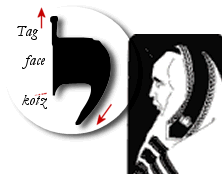
Entering the tunnel is the Hebrew letter qof. Its pictograph is a circle with a line through it. Qof implies separation from the pictograph, The biblical Hebrew version of the letter qof follows:


The Amazing Biblical Language: The Importance of The Letter ...


It is the eye of God (ayin) with the letter vav passing through it. Qof can be represented by ayin, divine vision and vav, the connection between heaven and Earth; thusly the needle that knits together in love (Col 2:2).


That was the metaphor of Jesus when He said, “It is easier for a camel to go through the eye of a needle, than for a rich man to enter into the kingdom of God” (Mat 19:24).

The vav can pass easily through the ayin for it is just a needle (some manner of connection.) However, a camel is the metaphor for the letter gimmel, shown next:


A blue logo with text

AI-generated content may be incorrect.A blue and black letter

AI-generated content may be incorrect.


Note that the vav (in the box) is a gimmel without the legs. The legs in the gimmel represent a man walking. The “needle” is without legs and, its closed version represented which is often written without the top (the letter yod). Hence, the closed vav is the “thread” and the ayin the eye of the needle.

However, Jesus said that it was possible, for the gimmel to go through the ayin. Remembering that vav represents both mankind and the Messiah as well; the letter vav is a firm thing. On the other hand, the letter gimmel is just the footprint of a camel, with the camel revealing its passage through by its effects on things that are seen (Rom 1:20). A rich man (vav) cannot get through but a Holy Ghost which the gimmel symbolizes can because it is not a material Thing.

First off, mankind (Adam) had the phantom Image (Strong 2006) of God breathed unto him (Gen 1:27). That Image could be characterized by the gimmel, a picture of a camel no longer there — a “ghost.” Adam was sanctified at his creation because the Holy Ghost was in him. That explains the letter qof at the door (dalet) in qadas, leaving only the letter shin at the end.

If qof represents the beginning of separation, as it does, the letter shin would represent completion of separation — “entire sanctification,” or glorification.

The letter shin represents release, indubitably to freedom from the things of the world by the consuming power of God. The letter shin also represents completeness consisting of three parts. Shin perhaps reveals the three substances of the divine Man, Jesus: Father, Son, and Holy Ghost as members of the whole.

Shin also represents fire, or holocaust. Luke wrote in the Acts of the Holy Ghost, “There appeared unto them cloven tongues like as of fire, and it sat upon each of them” (Acts 2:3) revealing the Power of the Holy Ghost of the Man, Jesus. Hence, the letter shin may also be the wholeness of God and the sinner made whole again (Mat 9:22).

So, if qadas (holiness, sanctification) is examined literally (and critically), the qof represents potentiality, the dalet The Way or passage, and the shin his three substances as in the beginning with Adam. Shin is holiness (set apartness) and qof includes the “whosoever” in John 3:16 and the means of setting whosoever apart via the gateway:


Enter in at the strait gate: for wide is the gate, and broad is the way, that leads to destruction, and many there be which go in thereat; because strait is the gate, and narrow is The Way (dalet), which leads unto life, and few there be that find it... Strive to enter in at the strait gate for many, I say unto you, “Will seek to enter in, and shall not be able.” (Mat 7:13-14, 24)


With that said, shin is holiness in the manner of God, Be you holy because God is holy (1 Pet 1:16). When the Holy Ghost came, the Christians there were set apart as holy. In other words, they were sanctified by the Holy Ghost taking them through the eye of the needle.

Peter was telling them to be sanctified, or set apart, from the whosoever’s.

Note that you can’t be holy without God. That gateway is where The Way of God comes in. You can get through the eye of the needle only in phantom, or as Peter wrote about, “Receiving the end of your faith, even the salvation (Yesua) of your souls (phantoms)” (1 Pet 1:9).

It is not just anybody that is set apart, albeit anybody has potential. (Is it just coincidence that the qof,  the Greek letter phi represents gravitational potential?)

Qadas seems to represent the process of becoming holy wherein it is Jesus who sets apart as the letter shin suggests, for He is the “godhead” Father, Son, and Holy Ghost.

Perhaps now you understand the process of sanctification better, or it could confuse you even more.


picture credit: foyr neo

Thursday, May 22, 2025

THE FINISH: THE JOTS AND TITTLES FULFILLED

Jesus was speaking to the Jews about the Law. “The Law” consisted of two parts: (1) Mosaic and (2) The Word, now wrongly called “The Ten Commandments,” which are the ten sayings (Exod 20:1) of The Word, Jesus.

“Thou shalt” in the Decalogue (“Ten Sayings”) is the Hebrew word, “yasa” which means come out or words to that effect.

“Not” is ‘lo in the Hebrew, meaning never. The Decalogue is “The Word” — Jesus, consisting of things that should go forth and things that should not.

There are nine “shalt nots” in the Decalogue, but two of them are one . They are things not ever to do, thus requiring no work. They are not burdensome because they essentially are ways to avoid “work.”

The remaining two are (4th) remembering the Sabbath and (5th) honoring your father and mother. Those two sayings are not work; remembering and honoring are cognitive — the way you think.

The New Testament makes a difference between the types of work: ergo for physical work and katergazomai for cognitive work (as in “work out your salvation;” Phil 2:12).

Therefore, the Decalogue, “The Ten Words of God,” are eight things you are not to do and two things to think about while not working: (1) Remember God resting and rest accordingly, and (2) honor your parents for bringing you forth. Those ten things should be easy to do but most people forger the Sabbath and dishonor their parents.

The “Law,” therefore should be easy to do, should they not? because you are to do nothing. That is grace; for doing nothing you are rewarded, are you not? That should provide you with a different outlook on the Law. Jesus did not find them burdensome, so He would not do away with the Law, and said so: 

Think not that I AM come to destroy the law, or the prophets: I am not come to destroy, but to fulfil. For verily I say unto you, “Till heaven and earth pass, one jot or one tittle shall in no wise pass from the law, till all be fulfilled.

Whosoever therefore shall break one of these least commandments, and shall teach men so, he shall be called the least in the kingdom of heaven: but whosoever shall do and teach them, the same shall be called great in the kingdom of heaven.” (Mat 5:17-19) 

Jesus begins with “I AM come.” Who is the “Great I AM”? Father God. God Himself had come in the flesh. Who wrote the Law? “I AM” (Yahweh). Jesus was implying that He is God, and it was by His “finger” that it was written (Exod 31:18).

Jesus had a “finger” before He came. God is characterized by the Hebrew letter Yod. The yod is an arm with hands and fingers. Jesus is the Yod of God, and His “finger” was the “pen of quick writing” of ancient literature.

Jesus existed before He revealed Himself to mankind. In other words, Jesus was always with us (the meaning of “Immanuel”) but the bodily image of Him was usually never seen. It’s not that Jesus was not with us, for He was, but the Jews and especially the pagans could not see Him because their eyes were dim to esoteric things.

John wrote that Jesus is “The Word” (John 1:1-14). He was there from the beginning but only righteous people and the humbled (at times) could see Him.

Jesus was not another Being, but God revealed, to wit:

Whosoever commits sin transgresses also the Law: for sin is the transgression of the Law. And you know that He was manifested to take away our sins; and in Him is no sin. (1 John 3:4-5)

“He” in that passage is “the Father” (1 John 1:1). The “Father” (Yahweh) was revealed as a real substance. It is not “God and Jesus” but “God is Jesus and Jesus is God.” Jesus is God revealed to mankind to “take away our sins,” as it says.

The “Name” in the Decalogue is “Jesus.” We are not to take that Name in vain, meaning with frivolity or triviality.

The Name, Jesus, is in the Law. Jesus is Hashem — “The Name of God” in the Hebrew. The Jews still do not understand; they are not to take the Name, Jesus, vainly. The Ten Commandments hang on Jesus as the love of God. They are ten ways to love God, be Him in Body, Spirit, or Holy Ghost.

The Decalogue is the “Law” and Jesus, the Yod of God wrote it. He did not come to destroy the Law but to fulfil it. The letter Yod is the Law and Jesus is the Father, Yod, revealed. Hence, Jesus is the “letter” of the Law.

The “Law” in the Decalogue are easy things, and Jesus would not remove one jot or tittle.

A “jot” is the Greek letter iota. The Hebrew equivalent is the letter yod. Jesus would not take the Yod from those Ten Sayings. Yod is said “Ya” as in “Yahweh.” Jesus would not remove God from any of those Ten Words.

Yod was said to have begun with a dot that spread until now it is the figure of the arm with hand. In a sense, “the pen of quick writing” with which Jesus wrote was the Power of the Yod which Power is the Hebrew letter aleph, representing the creative Power of “Father,” Yod.

Think of the letter yod as a dot as in dot-matrix printing; all letters and words, like jots or dots, are in each letter and word of the Law. The Ten Words were written with the letter yod in its simplest form. Take away any dots, then the word would be dimmed. Take away more dots and the words would not exist.

Many have seen dot-matrix printing where the printer missed dots; words there don’t make sense; and take God (The “Yod”) out of the Ten Sayings, and then they do not make sense.

Now for the word “tittle.” Jesus said, “It is easier for heaven and earth to pass, than one tittle of the law to fail” (Luke 16:17). “Tittle” in the Greek version is “keraia.” Keraia are “little horns” or “extremities” of the Hebrew letters.

Each letter points toward the next in words, usually in three characters in verb, object, and subject order. The aleph points toward the bet and the bet point toward the gimmel. God was first manifested as the Power of the “ox” (Aleph), then the “House” (Bet) or Flesh of God, and then  the Holy Ghost signified by the letter gimmel.

The three-in-one letters are the ‘Godhead.’ Take away any one, then the letter of the Law would not be the whole Law.

The crucifixion, for three days, took the Aleph and the Gimmel from the Bet, and they went their separate ways. Jesus lost His Virtue (the Aleph) in saving mankind and then gave up the Holy Ghost (the Gimmel).

As Jesus died on the Cross, He said, “It is finished” (John 19:30). Those words referred to the jots and tittles: ““Till heaven and earth pass, one jot or one tittle shall in no wise pass from the law, till all be fulfilled.” The crucifixion made the tittles meaningless — no longer did the points of the letters point to the next letter but were in disarray. The Godhead had been disassembled, and when Jesus was resurrected, he was “raised” or literally “assembled.”

It seems the word “tittles” referred both to the Hebrew aleph-bet and the Crucifixion followed by the Resurrection, so now you should know your jots and tittles and that the crucifixion fulfilled the Law and the ABCs.


The "tittle" would be the face of the letter yod in this case,


Wednesday, January 8, 2025

DUST TO DUST

 A SAMPLE CHAPTER FROM MY LATEST BOOK, A STAR IS BORN; JESUS CHRIST SUPERSTAR.


DUST TO DUST


There is a divine relationship between planets and animate beings. Not to support any new age philosophy, there is both a scientific and theological explanation for that.

First things first: The Word said to Adam, “for dust you are, and unto dust shall you return” (Gen 3:19).

There was an affinity between the new kind of creature and the ground of the planet Earth: Not only was it the Lord’s Garden, but it was the “ground” (Hebrew; adam) on which the LORD GOD planted the Image of Himself, so to speak. It was His own “Divine Seed” that was planted, and since the person, Adam, was of God and the ground, he was called the “Ground” (Adam in the Hebrew), or more precisely the dust, or atoms, of the ground. Mankind to this day have the same composition and in the same proportion as the elements of the ground itself.


Scientists think planets, including the ones in our solar system, likely start off as grains of dust smaller than the width of a human hair. They emerge from the giant, donut-shaped disk of gas and dust that circles young stars. Gravity and other forces cause material within the disk to collide. If the collision is gentle enough, the material fuses, growing like rolling snowballs. Over time, dust particles combine to form pebbles, which evolve into mile-sized rocks. As these planetesimals orbit their star, they clear material from their path, leaving tracks of space empty but for fine dust. At the same time, the star gobbles up nearby gas and pushes more distant material farther away. After billions of years, the disk will have totally transformed, much of it now in the form of new worlds. Watch the video to see this process unfold. (NASA n.d.)


Figure 2: A Planet Forming (NASA) (ibid)


Now compare the formation of planets to the formation of Adam: 

There went up a mist from the Earth and watered the whole face of the ground (adam)and the Lord God formed man (Adam) of the dust of the ground and breathed into his nostrils the breath of life; and man (Adam) became a living soul. (Gen 2:6-7) 

In my own caricature art, God’s formation of Adam was much symbolized by my own imagination. Artificial intelligence from the Paint application somewhat re-created the formation of the first Adam (see the figure below).


Figure 3: Formation of Adam (by Herrin)


As you can see, the Earth was the “turntable” on which the clay of Adam was formed. God provide the dust and the water from the ground (adam) and Adam was the offshoot that was created, or literally from the Hebrew, he was “cut.”

Cutting was the formation of the man, Adam, from the material substances of the Earth, and the pattern for Adam was the invisible Image of God Himself (Selem in the Hebrew). God cut clay from the clay of Adam has he formed it by His divine Hand.

Then as you can see from the following scripture, God took the prototypical man and planted him in the Garden of the Lord to multiply. Multiplication was not meant to be sexual, but some type of asexual reproduction of the Image of God, perhaps like a spiritual “cloning” of sorts. (The woman was the first “cloned” from prototypical Adam.) 

And the Lord God planted a garden eastward in Eden; and there he put the man whom he had formed. (Gen 2:6-8) 

“Eastward in Eden” was not directional but the antiquarian way of saying, “before time.” God planted Adam in the Garden before time, hence, all the Creation was before time began.

There were many characteristics shared by man and the planet Earth” (1) Their compositions are of the same elements, (2) and in the same proportions; (3) their creation processes were identical; (4) each were meant to be eternal, and (5) the same Divine “Hand” turned them both. The “spin” of both planet Earth and Adam were the same because the Earth, in a sense, was the “turntable” on which Adam was formed.

Many Jews have written that the “Foundation Stone” beneath the Dome of the Rock in Jerusalem is the very stone on which Adam was founded and that, that stone is the very “navel of the Earth” as well as the celestial axis of the cosmos. Hence, Adam and the “world” have the same origin — the center of the Earth or “ground.” [1]

I tried to demonstrate in figure #3 that premise. Note that the “invisible hand” of God is invisible in both figures #1 and #2 and that the foundation in my image might represent the throne of God, or perhaps more so, His footstool as scripture indicates (Mat 5:35) with His throne in heaven in a like but different realm. (There is some type of “cord” between God in heaven and us on Earth. (That “cord” is telephonic and genetic!)

Solomon said about death, “Or ever the silver cord be loosed” (Ecc 12:6). Life, therefore, would be the silver cord be bound, or even converged.

Furthermore, that silver cord, from the Hebrew, is literally “a pale twisted thread” (Strong 2006). A pale twisted thread is chromosomal and perhaps in two carbon helix chains, or DNA as it is now called. DNA is carbon based and from the dust of the ground that began as star dust before the foundation of the cosmos wherein time did not exist.

The Phantom of God might very well be chromosomal and since it is in the shape of a body, our version of that could be the “ghost” of a human being, or the human “soul.” [2]

The original symbiosis between the two is called “quantum entanglement” because of the different but shared characteristics. Of course, entanglement is on a sub-atomic scale, but God may have used the same kind of process on macro-processes. Ironically the man Adam is made of atoms and within all his atoms lies sub-atomic particles. The man and the planet even share the same atomic processes!

So, what is quantum entanglement? 

A property of a set of subatomic particles whereby a quantum characteristic (such as spin or momentum) of one particle is directly and immediately correlated with the equivalent characteristic of the others regardless of separation in space. (Wikipedia 2024) 

The “spin” for the planet formation is by the divine hand of God as it was for the man, Adam. The momentum of the planets in space, without resistance, is constant motion. In the same manner, Adam was to be constant, or the world to have no effect, nor affect, on him.

Space separated both Adam and Jesus from the planets. No wonder the former is the “first Adam” and the latter, the “last Adam” (1 Cor 15:45) because they were both “entangled” with Father God. “Father” indicates genetics. They were both “sons of God,” meaning that they were of the same genetics as God. Jesus was the “quickening Spirit” around which the first Adam’s Image was formed, from the same passage.

The point to all that discussion is that creation was a “symbiotic” process, to wit: 

Relating to or marked by symbiosis: characterized by living in or being a close physical association between two or more dissimilar organisms. (Merriam-Webster 2024) 

The creation of Adam was very similar to the formation of planet Earth, but dissimilar at the same time. Adam was in “symbiosis” with the ground of the Earth, so hence his name. His soul was symbiotic with God because of the Image of God within Him. Pre-incarnate Jesus was that phantom Image that stood on the molding turntable that I fabricated in figure #3 to symbolize the molding process of God.

Because Venus is the “bringer of light” planet, then Jesus and Venus are symbiotic, not in substance, but energy. Because Mars is without an atmosphere, it is a phantom planet for its light is the reflection of the Sun from iron oxide on its surface.

Mars mirrors the elements on its surface, so the light from it is basically a shadow of the planet itself. (Remember that a shadow is just a darker frequency of light because photons of light are in space and flash on and off so frequently that they go unnoticed). Mars would represent the Phantom of God — the Holy Ghost.

That leaves Jupiter. How is Jupiter and God alike? Jupiter is the Dynamic planet that shed many moons (95 some say) and the first planet in the solar system to exist. It is the “Father” of them all — the first planet seeded in the solar system and at one time, science says, was all alone until others were created. Perhaps God created those three planets to symbolize the Godhead, and He would have done so before the foundation of the world (the cosmos).

The planets grew, in as sense, from the most supreme of the light — the Sun and from the Sun, Jupiter came first and the others followed. Planets multiplied just as God meant for earth creatures to multiply; not by sexual dynamics but Spiritual Dynamics and Himself the Dynamic (Virtuous) Existence in them all!

Mankind was meant to be one body and that applies to the planets of Mars, Venus, and Jupiter; they were meant to shine as one when a certain event came at the right time.

Mankind was to be constant like the planets, always returning with quantum entanglement to reveal the Substances of God entangled with each other in the Godhead.

That “Superstar” that came from the three sub-stars; that was God’s creative attempt for mankind on Earth to understand that they were seeing the Godhead in formation with Jesus at its “head” with the shining light of Venus the most prominent.


[1] Life as we know it is probably not on any other planet unless it is of the same elements of those planets. Perhaps they should not be looking for mankind on Mars but living stones of another kind. If there is animation on other planets, they would be far different that God’s creatures here on Earth.

[2] Sacred literature describes the soul as the exact shape of the person’s body down to the fingertips and toes. That implies that the bodily shape of the Holy Ghost, and our soul, is the shape of our bodies but of a different substance.

Tuesday, December 17, 2024

SHALL BE; WILL BE; ARE

 Early church historians credited Luke with the writing of the Book of Acts. There is an argument about whether Acts was written in the first or second century. 

Since Luke credibly wrote the book, he would have written it before he died. Luke is believed to have died between 84 and 100 A.D. with the earlier date most accepted. 

Some of the apostles had died before 84 A.D. 

Paul-66, Peter-between 64 & 68, Andrew-69 or 70, James who died first after Judas-44, and so on. 

What has this got to do with anything? First off, The Book of Acts was written by a contemporary of Jesus — Luke — which means that the Acts of the Apostles were not legend but an historical account.


Luke was a credible witness of Jesus. He was the one writer who saw the Holy Ghost go into Jesus in bodily shape (Luke 2:33) and among those who saw the Ghost leave Him in the same manner (Luke 23:46).  Luke saw Yahweh, Father God, in Jesus. 

Luke new Jesus well and knew all the apostles well. He could write of The Acts of the Apostles better than the apostles themselves. 

Luke, and evangelist, was not an apostle, so he would not have written with biasness. As an evangelist, his job was to chronical the life and times of Jesus and the apostles as an historian. Think of Luke as the historian in the manner of Josephus whose history is the most credible of all historians. 

With that said, consider what Luke wrote about the salvation of those who had already died by the time of his writing: 

Now therefore why tempt you God, to put a yoke upon the neck of the disciples, which neither our fathers nor we were able to bear? But we believe that through the grace of the Lord Jesus Christ we shall be saved, even as they. (Acts 15:10-11)

 The key phrase therein is “shall be saved.” Paul and the other apostles had met and considered the matter of salvation as they dismissed circumcision. 

Paul was saying that they too like any of the disciples shall be saved. 

The criteria was one: “God, which knows the hearts, bare them witness, giving them the Holy Ghost, even as He did unto us” (Acts 15:8). 

Hence, any who had the Holy Ghost could be saved.   

How about the Holy Ghost? It was Christ in them.  Any of those were opportune for salvation; the question was when? 

Looking at the different translations, “shall be saved” could be also: 

·        We believe that we are saved through the grace

·        We believe that we and they are saved in the same way, by the grace

·        We trust and are delivered

·        We believe that we will be saved

·        We believe that we are saved

·        We believe to be saved

·        Will be saved the same way

·        God saves us who are Jews when we believe in Jesus

·        We believe that we are saved in the same way

·        We believe that we will be saved

·        Believe that the Lord Jesus saves us the same way that he saves them—through his kindness.” 

·        Believe and are saved by the grace

·        Believe that we and they too will be saved

·        We certainly believe … that we are saved, just as they are.

·        Believe that the Lord Yeshua saves us the same way that he saves them

·        Believe that we will be liberated 

They all believe in the process of salvation by the grace of God.

The “grace of God” is therefore those who have received the Holy Ghost.

They all believe that salvation of Christians is inevitable.

Shall be, will be, are in that manner, and such.

Belief indicates that there is no proof, but the evidence was that Jesus said the repentant thief would be with Him in Paradise “that day” — the day that he died.

Salvation is belief in a future event.

That you already are saved is a belief. The event occurs when? 

Paul, writing about Jesus, said to Peter, “Receiving the end of your faith, even the salvation of your souls (1 Pet 1:9). 

John’s purpose was for him to “go before the face of the Lord to prepare His ways; to give knowledge of salvation unto His people by the remission of their sins.  (Luke 1:76-77) 

When did the thief receive the Holy Ghost. When he died and when the Holy Ghost left Jesus to take his soul to Paradise where he was saved to another realm away from Satan.


Sunday, August 4, 2024

SEPARATING FROM GOD: FALLING AWAY

The Book of Ezekiel is prophetic; it is about the future as well as the present. As I wrote in an earlier commentary, “Israel” is more than the nation; it is also the descendants of Jacob, the Garden of Eden on Earth, The House (family) of God, the early Church, and even a symbol of the Messiah (Jesus).

One of the two meanings of the name “Israel” is “He Retains God” in addition to “God Is Upright.” Put the two together and retaining God is remaining upright. That implies two things: (1) That God can be abandoned and (2) that mankind can become slanted… inclined toward evil from once being upright.

Everybody perceives themselves as good, albeit they are born inherently evil. “The wicked are estranged from the womb: they go astray as soon as they be born, speaking lies” (Psalm 58:3). The only innocent ones are the unborn. If you have been born you are estranged, or a “stranger” to God; or as Paul said it, you “come short of the glory of God” (Rom 3:23).

Some Christians refer to strangers to God as “the lost.” They are indeed as “lost sheep” (Mat 15:24) but sheep who stray from the fold were once safe, were they not? Hence, “the lost” are those who once were secure in the House of God (i.e., Israel) but now are like strangers and foreigners amidst the household of God (Ephes 2:19).

The lost are those who once had affection for God but have defected (apostasia) from Him (Heb 6:6). Those who never knew God were never citizens of the household of God, so they were never lost.

(Words mean things in scripture, so it is important to not gloss over the Old Testament wisdom and prophetic sayings.)

Since God is truth, if He said it in the Old Testament, it remains the truth in the New Testament. The Ten Commandments remain the will of God; they are ways to demonstrate love. One who loves God would not adore a false image of Him, and likewise, someone who loves his neighbor would never steal from him. The Ten Commandments are what the household of God should do to remain within the family of God.

They are familiar traits required to remain a son of God. Those who do not do those things are strangers to God and others. They are not lost but know what they do. They are written on stone, so that those who are of the household of God know that they are. Those who gloss over the Ten Commandments are the lost and are strangers to God because they take the standards of God in vain.

Once a sheep; not always a sheep. Sheep can be food for the beasts. Referring to Christians, it is written: 

Casting all your care upon Him; for he cares for you. Be sober, be vigilant; because your adversary the devil, as a roaring lion, walks about, seeking whom he may devour. (1 Pet 5:7-8) 

Paul meant that you may be a Christian now, but you are vulnerable; Satan can transform even you into nothing more than a meal at the supper table of demons.

You may have been made safe, but walk too far from the household of God, and you become a snack for unseen beings.

Now consider the Israelites. They are God’s people. They were of the household of God who kept them safe from the Canaanites, the other “ites” and even Anakim giants — demonic men.

Israel himself (Jacob) carried the genes of God. All his descendants carried that gene. They were engendered from God above (“born again”), but they still could separate themselves from both God and His family, to wit: 

For every one of the house of Israel, or of the stranger that sojourns in Israel, which separates himself from Me, and set up his idols in his heart, and puts the stumbling block of his iniquity before his face, and comes to a prophet to enquire of him concerning Me; I the Lord will answer him by Myself: (Exod 14:7) 

The key phrase within that passage is “separates himself from Me.”

The prodigal son did just that; he was of the family of God and his own family. He took his inheritance and left both his earthly father and Father God. Upon returning to the fold, his father said about him, “My son was dead, and is alive again; he was lost, and is found. And they began to be merry” (Luke 15:24).

The prodigal son died when he left home. Death, in scripture means many things. He could have died a mortal death, or it could have been a spiritual death. The father in the parable was speaking of a genetic death. The son had died to him because he became lost to the family. If he had died away from his father and away from God, he would have denied both as his family.

He received his inheritance, so he was part of the family, but when he left the fold, he died.

The death of Adam and Eve was not that they physically died, but their genetics changed, and Cain became of the Wicked One (1 John 3:12). He was not lost, but was the first being that came short of the glory of God at birth just as is written. He was born dead in a sense because there was little “Adam” in him. He was genetically, never part of the household of God, and he was never lost but only “wandered” as his name means.

The prodigal son had the opportunity to again become part of the family and the household of God because Jesus has yet to be crucified. That has great significance: 

It is impossible for those who were once enlightened, and have tasted of the heavenly gift, and were made partakers of the Holy Ghost, and have tasted the good Word of God, and the powers of the world to come, if they shall fall away, to renew them again unto repentance; seeing they crucify to themselves the Son of God afresh, and put him to an open shame. (Heb 6:4-6) 

It is not impossible to fall away but impossible to renew them again after falling away. It would be as if crucifying Jesus again.

Note that Paul was referring to those who once had the Holy Ghost; those that have been engendered by Jesus and were in Christ. They once had affection for Christ, and they had  become part of the Household of God.

“Falling away” is apostasia in the Greek. It is to defect from Jesus after once having affection for Him.

Defection induces the Holy Ghost to remove itself from a “temple” where it is not welcome. The Holy Ghost is the Christ in the Christian. The Ghost of Jesus is just as much God as the Person of God — Jesus.

Tasting the good Word of God is not just sampling but partaking of the Word of God; ingesting both His Will and His Holy Ghost — in a sense eating of the invisible body of Christ.

God will never leave nor forsake you, but you are not in jail but a safe house to prevent the wicked ones from eating you. You leave the House of God like a prodigal son and with Jesus already crucified and His Estate probated, there is no inheritance to come back to obtain.

That you have been saved is indeed comforting, but that you can be devoured (unsaved) is irrational. Once devoured, always devoured, if you are the meal of demons at their “wedding feast.”

Look at Adam and the woman. They were safe in the arbor of the Garden of Eden but there they encountered the Devil who was cleverly disguised as some other image. They failed to be vigilant because they were in the household of God. When they least expected it, the woman was beguiled; she had ingested guile and no longer was she Adam’s woman, but a new kind that Adam called “Eve.”

Was the woman dead? Yes! She was no longer of man but of the wicked one and her child was demonic in countenance. The so called “Serpent” was really Lucifer, and his child was from the mother of all living (Gen 3:20). Eve’s kind was not “sons of God” but of the gens of Cain.

She had died because she was changed inwardly. She looked like Adam but was inwardly a beast.

(I believe that Lilith was the demon spirit within Eve, not before then, but after she had sinned.)

As such, the woman ate the fruit of Lucifer, thinking that it was the real fruit of God. She tasted wickedness and liked its taste more so than the ordinary fruit of God from the Tree of Life. She imbued wickedness whether she ate figs or any other fruit. Whereas before, the woman was glorious with the Ghost of God within her, and she died in the sense that God left her because she was by then filthy within: 

The works of the flesh are manifest, which are these; adultery, fornication, uncleanness, lasciviousness, idolatry, witchcraft, hatred, variance, emulations, wrath, strife, seditions, heresies, envyings, murders, drunkenness, revellings, and such like: of the which I tell you before, as I have also told you in time past, that they which do such things shall not inherit the kingdom of God. (Gal 5:19-21) 

Such things are guile that beguiled the woman to change her glorious kind into inglorious, coming short afterward of the glory of God. She died in the sense that she lost the twelve fruits of the Spirit of God and imbued the many fruits of the Wicked One.

Because, after sin, Adam and Eve were different creatures who would make a great meal for the demons, God put a garment on the two (Gen 3:17) for their safety from the fiery darts of the wicked ones.

Adam and Eve were kept safe by that impenetrable garment until Jesus died on the Cross to save them.

Since the time of Adam, mankind itself has lived in a state of safety for those who have remained children of God. The two Adams had to die to be born again. Except for the rapture, Christians must die to be born again. Rebirth begins with engenderment by God above and is finished at glorification, when those in Christ arise to be with Christ, “receiving the end of your faith, even the salvation of your souls” (1 Pet 1:9).

The salvation of your souls is either at death or the general resurrection. No wonder, Paul said that death would be gain for himself because he was in Christ (Phil 1:21), having Christ in him to the end.

You are kept safe, as the Greek word “sozo” also means, until death wherein the soul of those in Christ are finally “saved” (a secondary meaning.)

“Salvation” is the Greek word “soteria” which occurs at death whereafter the soul of the Christian is beyond the wiles of the Devil.

Words do mean things, especially the Word of God. There are not two conditions for salvation, there is one salvation, for Jew and Gentile alike. Any Jew that is engendered by Christ is as much a Christian as a Gentile about whom Paul wrote, “He is a Jew, which is one inwardly; and circumcision is that of the heart” (Rom 2:29).

Yes, you too require circumcision, not of the foreskin of the pudenda, but the hardness that surrounds the will of sinful men and women.


"The Fall of Adam and Eve" Goodsalt.


Thursday, June 27, 2024

EVEN CHRISTIANS DO NOT UNDERSTAND CHRIST

Generally, Christians do not know what they are talking about, so how would the non-Christian? They indeed are lost!

Christians rattle off biblical quotes until they become clichés. Of course, “God loves you,” is said often without the declarer understanding what love is even about. To many, love is love, just as the “woke” crowd believes. Strangely, love is not love as God defines it. However, the concept of love has been covered often and people still do not understand it.

Probable the best concept of love is from John 3:16: “For God so loved the world, that He gave His only begotten Son, that whosoever believes in Him should not perish, but have everlasting life.”

First off, who is the “world’? It is literally the cosmos. God loves what He has made and that includes objects, souls, and beings of all sorts. Foremost, God loves the souls of some people; those who trust Him. It is not that he has no empathy for the “lost” but that they deserve what is important to them. “The wages of sin is death” (Rom 6:23), so sinners get their rightful payment. Sinners are justly rewarded for their actions and thoughts.

James, the brother of Jesus, helped with that concept, “Wherefore lay apart all filthiness receive with meekness the engrafted Word, (in italics that which follows): which is able to save your souls” (Jas 1:21).

John wrote the conditions for salvation. The person must believe (pisteuo) in Him. People fail to understand what belief even means. — to have trust in something. Demons believe in God but trust Lucifer rather than God (Jas 2:19).

Believing in Jesus from rebirth to death — “…he that endures to the end shall be saved” — is saving faith. Hence faith is dynamic; and it is trusting God until the end. “Born again” is the moment in time when any sinner first believes, to wit: “…now is our salvation nearer than when we believed” (Rom 13:11), or better said, first trusted God for salvation of the soul.

Hence, the love of God is conditional but also unconditional in the sense that the free will that God endowed everyone with allows them to either choose eternal life or to reject it. Each person must decide whether they trust themselves for salvation, or God, all the while knowing that they have no power to save themselves. So irrationally, they reject God because they fail to believe that there is a resurrection of the faithful.

God is impartial; doing good things to gain His favor (works) does not bias the “Judge” who knows what is in the mind of the person. God detects sin by both thoughts and actions. James revealed the actions: “…lay apart all filthiness receive with meekness the engrafted Word.” Laying apart is the action and meekness the right thinking.

Martin Luther rejected that notion and sought to eliminate the Book of James as biblical canon.

Canon are the sacred books that are the genuine Word of God. Luther believed in sola gratia (by grace alone); so do most Christians. However, “works” are the evidence of gratitude for His Grace. Being engendered by God (born again) is made like God, or as many say without knowing what it means, “in Christ.” If anyone does not have the “engrafted Word” in them, they are not in Christ and their souls shall not be saved, as James rightfully acknowledged.

To understand what “in Christ” means, consider the “Word engrafted” within you. The “Word” is the actions of God, what He thinks, says, and does. It is the “Dynamic” of God that is in the Christian. Dynamics are just actions but in the case of those in Christ who are engrafted (entangled) with Him, they are good works, or “virtue,” and are also of the mind.

In this case, “entanglement” is like God but not God. Christians are not Christ but like Christ in their actions. We do come short of being like Christ!

Like the blind man who received his sight because of faith in the Christ, “Jesus said unto him, ‘Go your way; your faith has made you whole. And immediately he received his sight and followed Jesus in the Way” (Mark 10:52). The blind man who had just sat there became “whole;” he was engrafted with the Genome of God in a spiritual sense (“born again”). He had trusted Jesus one time, but once he saw that he was restored, out of gratitude, the once blind man followed Jesus in the Way — on the journey that Jesus was going. Where did the journey of Jesus end? On Calvary. The blind man may have not been at the crucifixion, but Jesus was crucified for him because of his faith.

The once blind man was to follow Jesus, not for just that day, but for the entire journey to his death, just as Jesus made his journey to His.

The journey for the blind man was the same journey for any follower of Jesus, “If any man will come after me, let him deny himself, and take up his cross, and follow me” (Mat 16:24). “Now” is any time on the journey and as Christians go the Way of Jesus, the journey leads to salvation, just as Paul wrote to the Roman Christians.

Since enduring to the end is the crucifixion of the body, the soul is saved once the person dies. Of course, Christians are to die to the world, but that would mean that they all become ascetics, giving up the world. That is “legalism,” or salvation by works.

At death, just what is saved?

The body returns to the dust from which it came, just as God says (Gen 3:19). The body of man (Adam) was made in Genesis part two. His soul was made before the foundation of the world, perhaps in the realm of heaven in Paradise, before the world was made in part two.

The soul of Adam was the invisible image that was like God but not God. The soul of mankind has the same substance as the Substance of God.

Like God, the soul is immortal. It can be compared to the Holy Ghost of Jesus; the human soul is immaterial but in the shape of a man (Luke 3:22). Although it cannot be seen under normal conditions the ghost of a Christian can be seen by its action. When Jesus was baptized, the Holy Ghost was seen by its movement onto Jesus in as wave-pattern like a dove would glide.

Christians cannot walk one way and the soul another way. They must walk together until death do them part.

The most important case of overcoming that parameter in the world was the event when the Body of Jesus went one way, and the Ghost of Jesus went another way. Jesus overcame the world because that was impossible theretofore. Now, because Jesus went one way in person and His Ghost went another way, Christians can do that as well!

Jesus was providing hope to His followers when He said, “Be of good cheer; I have overcome the world” (John 16:33). Because He could defy death, so can His followers… if they follow Him to their end when their bodies go one way (to the grave) as their souls are saved as they glide into another realm with ease.

Salvation is not physical. It is the soul that is saved from torments. All souls are immortal; the choice is where the person spends eternity. “Love,” then is God’s desire that the soul never perishes, just as John 3:16 indicates.

God truly desires that the body die, and Paul wanted his to die as well; he said, “For to me to live is Christ, and to die is gain” (Phil 1:21).

“Salvation” (soteria) is at death when the soul separates from the body and goes a different way. For Paul, it was gain because he was in Christ. If not in Christ, then the “gain” is the pain of torments. Paul did endure to the end and then suffered decapitation, according to legend. Why was that gain to him? Because he was entangled with Christ and would go where Christ had gone!

Many say with enthusiasm, “I got saved today!” Not so! They began to trust Jesus for salvation which should come if they remain faithful. (The unfaithful do not enter Paradise but Hell.)

 Whether they trust Him to the end is up to themselves since they are sealed by God (2 Cor 1:22). God will never leave nor forsake them, but they, again, are not God nor even gods. They can freely leave and forsake God as they want (Heb 6:6). God does not imprison them but puts a “garden” (gan; hedge) about them as Satan accused God of doing for Job. God keeps them safe, but as with Job, safety to the end was how far Job would trust in God. He trusted God all the way to the end!

So, God loves you so that He desires that you never perish. In other words, God has so much “goodwill” for you that your soul is indispensable in the eternal scheme of things. He will keep you “safe” (sozos in the Greek), but salvation occurs the moment that the end comes for you.

For most, the dead will rise in Christ, but for a blessed few, the living will be raised while alive (Thes 4:16-17). Only those living in Christ when Christ returns will have their bodies saved. All those already dead in Christ will be regenerated from the dust from which they came. God, indeed, can raise dry bones and put onto them tallow and flesh as He proved long ago (Ezek 37).

Your person will not be saved. You will not look like the ugly person that you are within. The human body is not the glorious body that Adam had. The flesh that you wear so proudly is at most temporary flesh that you wear (Gen 3:17) to keep you safe until the resurrection when those in Christ will have a genesis in the same manner as Adam and shall also be glorified.

Christians are blessed. The two glorious creatures, not Adam and Lucifer, but Adam and the woman Adam, were meant to be like God in mind and spirit. They failed God in mind, so their spirit was made devoid of their glorious flesh. The mind goes with the spirit wherever it goes since virtue is the dynamic (dynamis) of God.

Either way you go, your mind goes with the soul; somehow, just as Lazarus and the rich man went their separate ways but each retained their mental faculties (Luke 16).

So far, hopefully you understand love, rebirth, the soul, and the end; perhaps even trust and faith, but do you understand sin and glorification? That will be revealed next.


 Soul Leaving the Body;" DeviantArt.com