Showing posts with label sacrifice. Show all posts

Tuesday, June 9, 2026

ABOUT THRESHOLD CREATURES

 This is a blurb from my upcoming book, The Hidden Things of the Garden" which I encourage you to buy at month's end:

As Jesus was approaching death upon the cross, He began to sing in agony as if He was being turned inside out — the 22nd Psalm that God had forsaken Him; that God had withdrawn from Him. That seems ambiguous but Jesus would have been a threshold creature who would have the Glory of Himself come out of its cocoon, as if it was a complete metamorphosis. The “agony of Christ” would have been that painful change which we suppose that insects do without any pain.

That does seem stretching it a bit, but earlier Jesus had been temporarily transfigured, but the cross provided a complete and lasting metamorphosis; Jesus, no longer God in the flesh of a beast, He became God in glorious incorruptible Substance — the “Angel of the Lord” (Mat 28:2).

Caterpillars use either trees or branches to hang from to undergo metamorphosis. Jesus was put upon His Tree (Acts 5:30) — the Cross — to change from one substance to another. Jesus shed His flesh to become the glorious “butterfly” and later “flew” away to spread His Glory to the world.

Why the 22nd Psalm? He was singing about Himself a changing. He noted that He had God in Him, saying, “My God, why have You forsaken me?... But I am a worm, and no man…” (Psalm 22:1,6).

Using the tables in the Appendix, the “worm” is tola’ (תּוֺלָע) whose pictographs suggest a cocoon or similar thing. (CoPilot AI). A cocoon is a threshold existence prior to a transition as the creature undergoes metamorphosis. That was what Jesus was undergoing on the Cross.

The coccus ilicis which is believed to represent the “worm” in the psalm ready to undergo metamorphosis; the males “go through multiple nymphal stages and a pupal (cocoon) stage to emerge as winged adults, living only a few days in order to mate” (Grokipedia 2026).

Males undergo change but the female coccus ilicis becomes a berry-like thing from which crimson die is made. Coccus ilicis undergo a change like Jesus whose flesh bled crimson and His inner existence became the “butterfly.” God used His creatures to transform Himself. That is a smart move, God!

Jesus would have come into the world as a creature of flesh from the womb of Mary, just like any worm. His baptism would have been a stage of development with Him going from a divine “nymph” to an instar — stages between molts. The transfiguration would have been the second stage and the crucifixion the third. The final instar would have been the Resurrection of Jesus as an entirely new creature — the Angel of the Lord. (Instar simply means “likeness”).

In the same manner, Adam would have been a threshold creature going from a beautiful angel of the Lord to a beast, sort of a reverse metamorphosis due to decoherence from sin that reversed the normal process in defiance of God.

Stages (instars) of coccus ilicis development are much like windows catch the process in action. They are threshold creatures that look little like before or after. The same may apply to any of the hybrid sky creatures which take on different images: Anunnaki, watchers, Masikim, or even Adam, prior to becoming flesh-bearing creatures.

To understand the hidden things of God perhaps butterflies and their “worms” should be studied.

Jesus shed His flesh and became an Angel of the Lord. His life was much like the life of a butterfly.

Complete Metamorphosis (Public Health Image Library)

Saturday, December 7, 2024

HARD TEACHING: THE WATER AND BLOOD

Salvation is about both the water and blood of Jesus who came by both water and the blood: 

6 This is He that came by water and blood, even Jesus Christ; not by water only, but by water and blood. And it is the Spirit that bears witness, because the Spirit is truth.

7 For there are three that bear record in heaven, the Father, the Word, and the Holy Ghost: and these three are one.

8 And there are three that bear witness in earth, the Spirit, and the water, and the blood: and these three agree in one. (1 John 5:6-8) 

The “three-in-one” is the triune God, the “Godhead” of “Holy Trinity.” Somehow the triune God consists of three substances: Spirit, water, and blood. 

The three that bears record are the Father, the Word, and the Holy Ghost. Let’s pick them off one at a time; the Holy Ghost seems to be the Spirit of God. Both are indeed, “pneuma” in the Greek. The Holy Ghost is a “fragment” of the Holy Spirit in Jesus in the “bodily shape” of His Person: “The Holy Ghost descended in a bodily shape like a dove upon Him, and a Voice came from heaven, which said, ‘You are My beloved Son; in you I am well pleased” (Luke 3:22). 

Therefore, the Holy Spirit is the substance of the Holy Ghost in Jesus that was the Image of God in Him. 

What was the substance of the Image of God? (Gen 1:27) “God created man in His own Image, in the Image of God.” 

“Image” therein is “Selem” in the Hebrew. It is always best to examine the literal meaning of the original text; not versions of it; Selem means “to shade” and figuratively it would mean a “phantom”  (Strong 2006). 

Now for some philosophy. Plato’s answer to what is truth from “The Allegory of the Cave” is that the shadow of a man is a “fragment” of the man. Therefore, that Jesus is “Truth” is that the Holy Ghost is a fragment of the man. That agrees with the scripture above. Indeed, the triune God’s Phantom Image is a fragment of the Godhead, or Holy Trinity. 

Therefore, the Holy Ghost is the Holy Spirit of God. That takes care of one substance of God. 

From John 1:1-14 it is known that “The Word” is the Person of God, Jesus. His Person was independent of His Substance. The Word was the “Voice” that walked in the Garden in the Image of a man; “They heard the Voice of the Lord God walking in the Garden in the cool of the day” (Gen 3:8). 

Hence, two substances of the Godhead are known: (1) the Spirit — the Holy Ghost — and (2) the Word. 

That leaves the third substance to be defined: that is “The Father” figure. The “Father” is the Creator; therefore, He is the Power. In the Greek, that Power is the “Virtue” of God, or in the Greek, “Dynamis.”  Because all the things of the Father were “very good” (Gen 1:29), then the Power of God was very good. God’s “Dynamic” was good, or virtuous. 

So the third substance of God is “Goodness” agreeing with the Word, Jesus, who said, “Why call you Me good? none is good, save one, that is, God” (Luke 18:9). 

However, God is also Light: “God is Light, and in Him is no darkness at all” (1 John 1:5). Virtue is therefore Light and Light is Power. Power drives any process, including the Creation. 

Since Jesus in the manner of Adam has the Image of God within (1 Cor 15:45), then when Jesus is looked upon, God is manifested. 

Jesus said to Philip, “He that has seen Me has seen the Father…” (John 14:9). 

The “Father” was in Jesus. He was the Power or Virtue in the Person of God. When Jesus healed the people, raised the dead, and made the sick whole again; that was the “Father” in Him. 

Paul told the Romans that he had worked many wonders, “by the power of the Spirit of God… I have fully preached the gospel of Christ” (Rom 15:19). 

Therein is the triune Godhead: Power, Spirit, and Christ. 

It is difficult to think of a “substance” as Power but so it is. Indeed, God is “Light.” 

Now consider, “there are three that bear witness in earth: the Spirit, and the water, and the blood.” 

Spirit = Ghost.

Blood = Jesus.

Then, water must represent the Power of God. 

Jesus said to the woman at the well, “He that believes on Me, as the scripture has said, out of his belly shall flow rivers of living water” (John 7:38) 

“But his spoke He of the Spirit” (John 7:39). Therefore the “water” is not the Spirit per se but the “living water” — the Dynamic and Power of the Spirit flowing. 

“Water” in that passage is metaphoric.

From where in scripture did that come? “…the wellspring of wisdom as a flowing brook” (Prov 18:4). 

The “wellspring” is figuratively the source of life. God once created man by what? 

“There went up a mist from the Earth and watered the whole face of the ground, and the Lord God formed man of the dust of the ground” (Gen 2:6-7). 

The LORD GOD formed man from the wellspring of living water. That “wellspring” is the Power of God that made man a living soul. 

That “water” was special. It was a “vapor” or Dynamic Spirit of God that formed Adam, and as the “last Adam” that was in the womb of Mary to form Jesus. 

“Water” (mayim in the Hebrew) is figuratively “semen” (ibid). God divided the “semen” from the “semen” to make things. 

Not only was God light, but He was “husbandman” as well, according to Jesus, “

I am the true Vine, and My Father is the Husbandman” (John 15:1) 

In the Hebrew, the “Husbandman” is the ‘IS (pronounced eesh). That means that God is the “extant” one (ibid); He is “Existence” and all things came from Him. 

“Husbandry” is a vocation nowadays. Husbandry is mostly selective breeding to improve herds and crops. Husbandry is about genetics, and not by coincidence so is the Christian doctrine of rebirth — “Marvel not,” said Jesus, “you must be born again” (John 3:7). 

That is animal husbandry. It is people improvement, literally “born again” is “engendered from (God) above.” 

People improvement is making mankind whole again, or glorious like Adam was designed to be — a man with God within Him, “in Christ” so to speak. 

The “Vine” is conductance. People improvement emanates from the Father to Jesus then unto the lost who are the “branches” as Jesus said, “I am the Vine, you are the branches” (John 15:5). The living water emanates from the Father to the Son to imbue Christians. 

The blood of Jesus is the “wine,” representing the genome of the Father in Jesus.via the blood, and the water represents the “wellspring” of the “semen” (the genetics) of God through the Vine to the branches to imbue Christians with the Spirit of God. 

Born again is that “living water” that flows from the Father, to the Son, and into us. It must proceed from the belly of Jesus for the circuit to be complete… Jesus said, “I am the way, the truth, and the life: no man comes unto the Father, but by Me” (John 14:6). 

Jesus is “The Tree of Life.” Whatever fruit that grew on it represents the Virtue from the “belly” of Jesus. The Vine is the tree trunk, the branches Christians, the root, the Father, and the mist from below to grown the fruit is the living water dynamic within the tree for the healing of the nations (ethnos in the Greek) — the genetics of anyone. 

Perhaps the “Tree of Life” is Jesus sharing the living water of God to all who would drink of it (John 4:10).

SUMMARY: 

The “water” therefore is “born again” — engendered by God above via Jesus the Vine. It is the Dynamic of Jesus as the “Aquaduct” for life to us from the Father. It conducts the genetic of the Father to us the “branches” and the blood flows from the Vine to us. The “water” is the dynamic that transports the genetics of God to mankind.


Monday, April 8, 2024

THE PASSION MORE THAN A PLAY

Even the most casual things in the Bible can be glossed over. Every move that Jesus made was a fulfilment of the prophesies of the Old Testament. That makes sense since the ‘Word’ of the Old Testament is Jesus. He came, not only to fulfill the commandments of God but the words of the prophets as well.  Jesus said, “On these two commandments” — love of God and others — “hang all the Law and the prophets” (Mat 22:40). Today, one of those will be discussed.

Remembering that every word means something, each word should be taken seriously. Matthew wrote the following, speaking of the murderers before Jesus was sacrificed:

When they had platted a crown of thorns, they put it upon His head, and a reed in his right hand: and they bowed the knee before Him, and mocked Him, saying, “Hail, King of the Jews!” (Mat 27:29)

Now, consider some of those key words: “They” is neutral. They represented all of mankind. You may have been there mocking Jesus, but each sin that you perform is mocking Jesus. He died for your sins as well as those who persecuted Him; we are just not so transparent with our mockery.

Mockery is the essence of sin. His Words are truth and disregarding the truth is mockery. Sinful men and women are indeed like little children who without any reason mock others. Not only can Jesus not be mocked, but neither can anyone else. Christians must have goodwill both for God and others, even their enemies.

They all were responsible; those there who did nothing were as responsible for those who platted. Those who placed the crown of thorns did the weaving of the thorns into the hair of Jesus, but those who looked on, weaved the web that snared Jesus… platting is weaving whether it be weaving hair or weaving a web of deceit. Narratives are as much platting as entangling objects into the hair. They all weaved their webs in some fashion; the weaver of the webs was as bad a weaver as those who platted the crown.

Unknown to them was that all of them were acting out what was practiced so long ago. Jesus said about them all; “They know not what they do” (Luke 23:34). They were good performers, knowing their lines by heart. They were all actors in a Divine Play. The ones who acted in the parts were no more to blame than those who observed the ‘Passion Play’ performed that day. (It was certainly no play!)

God did it; it was His Divine Play. Jesus explained it to Pilate, “You could have no power at all against Me, except it were given you from above” (John 19:11).

Pilate was the chief support actor in the Passion Play. He was just performing for God. When was Pilate engendered with the Power of God? When Jesus put up no defense, “The governor marveled greatly” (Mat 27:14). At what did Pilate marvel? That innocent blood was about to be done under his authority: “(Then) he took water, and washed his hands before the multitude, saying, I am innocent of the blood of this just person: see you to it” (Mat 27:24).

He was the one responsible for the ‘goat’ that escaped, according to scripture: “He that let go the goat for the scapegoat shall wash his clothes, and bathe his flesh in water, and afterward come into the camp” (Lev 16:26).

The scapegoat was to be brought into the camp, according to Mosaic Law. Although Pilate was ostensibly a Roman, he was less than that. Many believe that Pilate, based on naming conventions, was not even a Roman patrician but a common plebian, from who knows where, whose family had settled in Rome from unknown places. As such, based on Roman cognomens, Pilate himself would have no power. Indeed, Pilate had been there at the right time for this common man to perform the greatest story ever told.

That Pontius Pilate would be king and judge for a day, effectively a ‘Caesar,’ with that authority, was written into the script long ago. Every one of his actions placed him at Calvary that day to do that dreadful thing.

Pilate was the one “that let go the goat for the scapegoat” from the Law. What did Pilate do? He performed the Passion to a tee; The Law revealed what Pilate had to do after releasing Jesus Barabbas — “Jesus, the Son of the Father — the scapegoat. According to the Law, that one would “wash his clothes, and bathe his flesh in water.” Pilate did that! He washed his hands of the entire ordeal.

Many speculate about whether Pilate became a Christian or not or was he just performing for the Jewish audience. He marveled! Jesus had said to another ruler, Nicodemus, “Marvel not; you must be born again” (John 3:7).

Pilate was the one that was chosen by God back when the Law was written. He was chosen to release the scapegoat, and Pilate, millennia later, released the scapegoat, Barabbas, according to the script for the Passion Play. Pilate was not really playacting, but the part became real for him.

The ruler, Nicodemus, was not to marvel. He was not the ruler that would be in the Play; it was not his part to shed innocent blood. However, Matthew wrote that the “governor marveled,” speaking of Pilate. He was the chosen one to act out the Passion play. God had engendered him from above. How was that ‘rebirth’ accomplished? Pilate saw that Jesus was God in the flesh, and he understood the play before it was played out. Pilate understood through his mental faculties without knowing scripture that an innocent man was about to die for sins that they had committed! That was proven by the Passion of Jesus. Pilate concluded that Jesus was who He said He was; “I find in Him no fault at all” (John 18:38), and at His death, the Holy Ghost left Jesus, and Pilate was vindicated — Jesus was God… who He said He was.

So, did Pilate become a Christian? According to the Law, the one that released the scapegoat, after cleaning himself, would “come into the camp.” It does appear that Pilate marveled; he was the one! Pilate came into the camp; he became one of the Christians that followed Christ. History reveals that Pilate was no longer of the Roman camp after that performance. He was not just an actor selected so long ago but became part of reality. He was not just blindly reading the lines of prophecy but became persuaded that Jesus is who He said He was.

Pilate was Platonian, asking Jesus, “What is truth?” (John 18:38). Jesus performed another play written by Plato three-hundred years earlier — “The Allegory of the Cave.” Jesus used Platonian philosophy to reveal the truth; God made the world a ‘cave’ with its darkness, shined the Light on Jesus, and revealed that the ‘Shadow” was a fragment of the Man, and just as real as the Man Himself.

God proved using Plato’s allegory that the Holy Ghost was just as much God as the Man Himself. He washed his hands of the action and became one of them that were in the back row of the audience. He became the audience, washing his hands of the action!

Pilate was just a supporting actor to get the message across. He became an ‘angel’ for the day. Jesus, however, was the Lead Man. He was crowned that day. His part was not the greatest act ever made, but it became real with Him in it. He did not perform, but God became the ‘lead actor’ to prove His Power of persuasion.

A Passion Play would never convince anyone to become a Christian, so His Play was performed live to reveal to the world the truth behind the action. Actors would not suffice, so God sacrificed Himself to reveal the truth. God made Himself the Truth so that the audience could see the truth. (Acting out Christianity still does not work; the sacrifice must be real!)

When the crown of thorns was placed on the cranium of Jesus that was planned as well. The place was named ‘Golgotha,’ literally “the place of the cranium.” Adam was there, not in the audience, but the performance was for him as well as the real blood of Jesus that was sprinkled on the skull of Adam whose bones were beneath the cross in the ground.

The audience, standing on the ground (Adam in the Hebrew), observed from above, but the best seats were below where the eternal audience became part of the showing. Once the Passion was performed; they stood erect and went into the city to spread the Good News that the play was so Good that the Lead actually died! Speaking of the dead saints, Matthew looked at those in the good seats on Good Friday and saw the response of the audience; they had come alive and had a good part in the play that was rehearsed all their years: “And (they) came out of the graves after His resurrection, and went into the holy city, and appeared unto many” (Mat 27:53). Unknown to those above; the old timers (saints) were brought together for the Grand Finality… They roared with applause when Jesus said, “It is finished” (John 19:30). Even the dead stood up for the Greatest Story Ever Told.

Abraham and Isaac would have stood tall that day and be some of the first to praise the Lord. They had rehearsed it long ago, but they now saw it played out in truth as rehearsed long before, to wit:

And He (God) said (to Abraham), “Lay not your hand upon the lad (Isaac), neither do you any thing unto him: for now I know that you fear God, seeing you have not withheld your son, your only son from Me. Then Abraham lifted up his eyes, and looked, and behold behind him a ram caught in a thicket by his horns: and Abraham went and took the ram and offered him up for a burnt offering in the stead of his son. Then Abraham called the name of that place ‘Jehovahjireh:’ as it is said to this day, “In the mount of the Lord it shall be seen.” (Gen 22:12-14) 

God rehearsed the Passion of Christ, using Isaac in place of God’s Son, and Abraham as God Himself. The rehearsal is believed by many to have been performed on the same stage. Perhaps Mount Moriah was Calvary as some believe!

In the rehearsal, Isaac, playing Jesus, escaped. The ram took his place. It was just a performance, but in the real Passion, Jesus did not escape; however He did wear the crown of thorns that the scapegoat wore.

Do you really think that them placing a crown of thorns on the head of Jesus was arbitrary? That had been rehearsed long ago; the “thicket’ that the ram sheep had on its head represented the crown of thorns on the head of Jesus.

Mount Moriah had a new name because of its purpose — “Jehovahjireh” — and sure enough, at the crucifixion, “the mount of the Lord was seen” just as Abraham said it would.

Genesis 22 was as much a showbill so that the world would understand that Mount Moriah was just a rehearsal, using body doubles, that would suffice until the real players came together 1500 years later for a ‘play” so true to reality that it did not just seem real but was reality.

Sometimes when I see a show, in jest I comment; “They had to kill a lot of actors to make that so real!” That is what God really did. He killed Himself to make the Passion more than a play, but the real thing!

picture credit; Redbubble; "Agnes Dei"


Tuesday, January 30, 2024

FEARING THE BEAST WITHIN

Jesus often quoted scripture. As I have written before, the New Testament is not the scripture when Jesus spoke because it remained unwritten and certainly unpublished. The Old Testament is ‘scripture’ in the sense that it is the written Word of God.

Jesus, as the Word (John 1:1-14), spoke those words to the prophets and patriarchs by divine inspiration (2 Tim 3:16).,

Jesus healed the blind (Mat 21:14) and the chief priests and scribes saw the wonderful things that Jesus did, but were much displeased (Mat 21:15).

Neither the chief priests nor the scribes could heal anybody. Jesus, they surely felt, stole their glory. That remains a problem to this age, to the extent that in 2005 the Stolen Valor Act was enacted in the United States.

Think about their thinking: We do all the work, but this Man gets the glory! Just as scripture says, their thoughts were not the Thoughts of God (Isa 55:8).

The chief priests and Pharisees, at least one of them asked Jesus, “Hear you what these say?” They were saying, “Hosanna to the son of David” (Mat 21:15) — Oh, save us, son of David.

Why were they angered? David was king, not a priest. King Saul, long ago, assumed the role of priest and did the things that the chief priest Samuel was to do. Saul stole Samuel’s valor, and “The Lord repented that He had made Saul king over Israel” (1 Sam 15:35).

Jesus was doing their jobs! That goes deeper than it first appears. The job of the scribes was writing copies of the scripture. Perhaps there was jealousy because they only copied it, but Jesus wrote it! Jesus was stealing their valor.

As for the chief priests, they enforced the 613 Laws, but Jesus wrote them as the Word in the Old Testament.

Think how their feelings were hurt when Jesus asked, “Have you never read, ‘Out of the mouth of babes and sucklings you have perfected praise?’” referring to God.

The scribes had written that perhaps hundreds of times, and most certainly the chief priests had read that as many times.

Now think on how smart we feel when we quote scripture. The point that Jesus was making was that writing about the Word of God and even reading it is not soterial.

That is likely a new word for you; soterial means ‘relating to salvation’ (Merriam-Webster 2023).

In fact, that hits me squarely in the face; I read the scripture and write a commentary nearly every day, but that does not make me a Christian nor will it save me. It makes me feel righteous but does not make me righteous. Merely reading and writing scripture can be merely placebos unless those precepts are lived.

I do all the hard work, ala the priests and scribes, but that brings me no glory. If I get any glory for what I do, that is valor stolen from Jesus.

Jesus was effectively asking them, Do you not practice what you read and write? To be honest that applies to me as well. Often, I find myself doing the very things that I write that should not be done. Each time, the only solution is to turn to Jesus and give Him the glory that He deserves. The scribes and priests would not do that, but the little children did!

Jesus quoted what both parties should have known by heart, and perhaps they did — “Out of the mouth of babes and sucklings you have perfected praise?”

Again, what were the children saying? “O save us, son of David.” They gave credit to Jesus as both King and High Priest. David was not; he could not save. However, the children saw that Jesus was the legitimate King of the Jews, which He was, and was also God Himself.

Why would that bother the scribes and Chief Priests. Since Jonathan Hyrcanus was both king and chief priest not too many years before, that the chief priests aspired to the Davidic Throne. Those children did not see the chief priests as kings, and the latter were sore about it. They surely desired the esteem that Jesus was getting. It was them who struggled to save the Jews against the adversaries, and here was Jesus who they saw as the ‘Adversary.’

Jesus had been caught doing wonderful things before, and along came the Pharisees who accused Jesus: “This fellow does not cast out devils, but by Beelzebub the prince of the devils” (Mat 12:24).

The children were calling Jesus Savior and King. The religious leaders claimed Jesus to be the Devil. They believed that they could cast out Devils; they could not, so the two chief priests had Jesus crucified not too long after. Jesus was steeling their glory. How so?

Royalty have ‘Houses,’ using the name of their leader. The chief priest at the time of the crucifixion was Caiaphas. He was the fifth chief priest in the ‘House of Annas” who was there with Caiaphas to put Jesus in his place. Caiaphas was royalty in a sense — he was of the House of Annas, and they were there to defend their aspirations. Jesus was outperforming them, and the multitude loved Jesus as much as they despised the chief priests who enslaved them with the Law.

Jesus called them out — You know scripture, but you fail to live scripture. He seemed to belittle them, but it was the truth. They, however, were not humbled, but were very agitated, so much so that those two men would soon have Him killed.

Jesus quoted scripture. That was His defense against His accusers. Without a written account of the gospels, Jesus quoted a Psalm from the Old Testament: 

O Lord, our Lord, how excellent is your Name in all the Earth! who has set your glory above the heavens. Out of the mouth of babes and sucklings have you ordained strength because of your enemies, that you might still the enemy and the avenger. When I consider your heavens, the work of your fingers, the moon and the stars, which you have ordained; What is man, that you are mindful of him? and the son of man, that you visit Him? (Psalm 8:1-4)

 Jesus knew that they knew all that song. They had read it over and over and even sung it in the synagogue. Jesus was good at projecting His Thoughts. He merely quoted one verse that would bring to mind the rest of the story. That is what songs do? Just start singing a tune and then stop; those who listen will grasp the whole song if they know it well.

He said one short passage, but what would they think? He claims to be our Lord and that His Name is excellent. He claims to be the Creator of the heavens and the Earth, just as the song says. And to further antagonize them, Who are they to come visit Him?

Jesus never attacked them. He let them judge themselves by filling in the blanks to the Psalm. They were nothing compared to Him, but here they were questioning His Lordship that he had just displayed by doing things that only God could do!

Jesus said so much by saying very little. He did not claim the be the Lord God. However, they must have feared that He was God, or perhaps just a king. They had no reason to fear Jesus; they should fear nothing more than fear itself. They should not have feared Jesus who had done so many wonderful things but fear themselves who had done so many awful things.


Thursday, October 19, 2023

STRONGHOLDS

Because sin is genetic, even Christians still sin!   

If we confess our sins, he is faithful and just to forgive us our sins, and to cleanse us from all unrighteousness. If we say that we have not sinned, we make him a liar, and his word is not in us. (1 John 1:9-10)

 Some misapply that, but it is clear therein that Christians still sin. How that can be done is because of grace. God overlooks our thoughts and actions if the Spirit of Him is in us. In fact, we still sin because of the nature of the Wicked One is in our flesh. Before anyone is without sin, the flesh must be not just circumcised, but crucified. Indeed, that is complicated because Paul wrote what seems to be something much different: 

For if we have been planted together in the likeness of His death, we shall be also in the likeness of His resurrection: Knowing this, that our old man is crucified with Him, that the body of sin might be destroyed, that henceforth we should not serve sin. For he that is dead is freed from sin. (Rom 6:5-7)

 When Jesus was crucified, the ‘old man’ in all Christians were vicariously crucified with Him. Also, when Jesus was resurrected, the ‘new man’ was vicariously resurrected with Him. If you are reading this right now, you are either in heaven or on Earth. Neither place is the resurrection of the dead. It is as if you have been resurrected; it is the hope of the resurrection, and as such the death of the old man is vicarious as well.

The flesh dies when? At physical death because it can sin no more. No wonder Paul wrote, “For me to live is Christ, and to die is gain” (Phil 1:21).

The crucifixion for Christians is at death, so until then, crucifixion is willingness to die to the world. Paul added, “We should not serve sin” because Christ in us freed us, not from one sin, but sin in general — the practice of sin, or iniquity. Iniquity is perversity, not merely failing one time, but remaining the ‘old man’ within.

The ‘old man’ puts up a good fight. Sure, the flesh is weak to sin but strong against God. That brings up what scripture calls ‘strongholds.” 

For though we walk in the flesh, we do not war after the flesh: For the weapons of our warfare are not carnal, but mighty through God to the pulling down of strong holds; Casting down imaginations, and every high thing that exalts itself against the knowledge of God and bringing into captivity every thought to the obedience of Christ. (2 Cor 10:3-5)

 Now consider ancient warfare. When offensive warfare failed, enemies would most often erect a fortification on a hill so to see the enemy coming. That was a last resort. The fort was their stronghold; it was the last resort to remain in control.

Our flesh, in its war against God, has put up and invisible barrier between itself and God. The warfare waged between self and God is as invisible as God and the soul of a Christian. The war is never ending in this world, but death concludes it; “He that shall endure unto the end, the same shall be saved” (Mat 24:13). The flesh is not going to be crucified without a fight and that fight ends only at the death of the flesh.

Ancient warfare was battling from a stronghold, and as was most often the case, the opponent would lay siege. A siege consisted of cutting off all means of nourishment and ammunition as well as outside help.

Our battle from our strongholds, if we are in Christ, is us alone against God. Satan is nowhere to be found because we are strictly Christians that have weak flesh.

Satan will never fight to keep Christians safe but only to perish. Hence, it is Christians against God in that war for everyone else already belong to Satan.

Like in the days of Job, Satan must remain at large and is restricted from killing, so cease saying that Satan is strong! That magnifies him, but the truth is that your flesh is weak, as Paul reminds us.

So, there on his hill is a Christian taking his stand. He has already relinquished so many sins to God that there will be no more pacification.

One person of whom I am thinking endeavored to be a Christian, and was willing to sacrifice much, but refused to sacrifice her sexual independence. Her stronghold was her own flesh. It kept her in bonds in an invisible fort as a last stand against God’s will for her.

Strongholds are not just things that must be overcome, but things that have the possibility of overcoming even Christians. Some will refuse to give up their strongholds even until death do them part! (You will in the end give them up, whatever they are!)

Paul wrote about pulling down strongholds; it is a battle, “Casting down imaginations, and every high thing that exalts itself against the knowledge of God and bringing into captivity every thought to the obedience of Christ.”

Paul brought up pulling them down to define what strongholds are; they are vain imaginations and that our thoughts are higher than His Thoughts, which, by the way is pinpointed long ago, “For my thoughts are not your thoughts, neither are your ways my ways, saith the Lord.” (Isa 55:8)

What were the woman’s thoughts and ways? That if God desires her from abstain from sexuality, then her thoughts would exceed His. With that, she would be the ‘god’ and not Him!

The Lord knew physical laws; that for every effect there is a cause, and for every cause an effect. God revealed causation; that your thoughts guide your ways. Your thoughts are the cause and your ways the effects.

The woman’s thoughts were what condemned her. She imagined the pleasure of sexual encounters and just the thought would be her way. Her sin was thinking wrong thoughts, and her flesh just obeyed. Nowhere was Satan to be found in her stronghold because he wanted her to be alone with her thoughts.

Strongholds are more wrong thoughts than wrong behaviors. “Whosoever looks on a woman to lust after her has committed adultery with her already in his heart” (Mat 5:28) which points to the thoughts and superior to the actions. (Even Jimmy Carter battled with that, as he admitted.)

‘Fornication’ is not so much the act than the thoughts. The Greek word for it is ‘porneia.’ Porneia is the actions that come from the thoughts of pornographos.

What in modern times is pornographic is images of the real things while the real things are sexual activity, porneia. In other words, pornography is the thoughts that lead to the ways, and thus fornication is first in the mind as people think about what they would like to do, and eventually, it will come to pass because of cause and effect.

Stongholds are against you even as you think they are for you. Sexual ‘independence’ was what the woman wanted and soon it was what she obtained. She sinned against herself, as Paul wrote, “Flee fornication. Every sin that a man does is without the body; but he that commits fornication sins against his own body” (1 Cor 6:18). So, that sexual stronghold is not freedom at all, but as if having chains about you; chains that you have put on yourself.

Now let’s analyze that for a moment. The mind that is on porno is out of control. Recently several men admitted that they were addicted to pornography. Their thoughts controlled them. That is not to say that they were addicted to sexual activities but the thoughts of such activity.

To overcome strongholds requires not only God in control but self-control. “Meekness, temperance: against such there is no law” (Gal 5:23). Temperance is self-control and meekness is realizing that you are out of control.

Think of that as you in the driver’s seat. and you should avoid every obstacle in the way. However, in the background God reveals to you the things that may kill you. His Word is safety but your refusal to listen is you trying to control the vehicle on your own. Your obstinate mind may be the danger — the cause, and death — the effect. God is in control, but in a sense, you are His ‘instrument.’

Ancient strongholds were torn down when the sieges ended. There were two ways to the ending: (1) fight to the death, or (2) submit and hope for leniency.

God will always win! That’s the absolute truth. You may fight Him to your death, but in the end, He remains in control, and you are history. It is God who remains alive and in charge and you that will perish.

The other possibility is to relent; admit that God is stronger than your stronghold. That is to admit, and then to relent self-control to God controlling. With that done, you endure to the end, but not with you in charge, but God. Either way God wins but He wants that you win, not to remain in bondage but be free of the stronghold and Him still having the Authority.

Think on the possibilities of you in charge; it will be like the Hamas whose stronghold is that tiny Gaza strip. They are essentially fighting Israel for a country the size of New Jersey all the while thinking it is Paradise and its virgins that are the reward. Are they really fighting for God or is it the pedophilia — the thoughts of young girls that their fleshes desire. They are fighting for their vain imaginations just as Paul said it! There are not seventy-two virgins and if there were, they would never want maniacs for sexual partners! They are fighting for nothing, and that nothingness are their strongholds.

Each one of us must crucify our flesh. That is to give to God our strongholds and He will take care of them! Most often, the strongholds are secret sins, sins that are so depraved that Christians are ashamed that they have them.

Each Christian has a stronghold. Do not be ashamed because strongholds are genetic. Most often, the stronghold is sexual because many of us believe the first sin was sexual. (The reason for aprons of fig leaves that still left little to the imagination.)

What we can be ashamed of is that they are never submitted to God for Him to end the siege that we have put ourselves into. Given us or God, God will win! So, why fight a losing battle?

The enemy is not God; “We have met the enemy, and they are us” (Pogo).

The devil stands back and laughs at our gullibility. He wants us to think that if we still sin, then the battle is lost. God does not sentence a trespasser for trespassing one time but squatting on His Estate as if we are the owners and Him the Tenant.

Sin can be discarded like a dirty tissue. You just seriously ask for God to dispose of it, and be sorry that you dirtied His Estate, and those trespasses will be forgiven. Satan’s goal is to perish the Estate of God (Isa 14:13-14) and one way to do that is for it to be destroyed by filthy things.

Sin on God’s territory? Don’t even think about it because by doing so, you have already vicariously done so!

 Next, the healing of the multitude will be examined more closely.

(picture credit: CNN; "Gaza Destruction")


Thursday, February 23, 2023

MARVEL NOT: Born Again?

 Nimrod was set on building a tower to heaven; the “great hunter” would hunt down God on God’s own Estate.

Abram of Ur refused to obey the king as well as his father, Terah. The Book of Jasher, mentioned several times in scripture, says about that, “The man who revileth the king should be hanged upon a tree; but having done all the things that he said, and having despised our gods, he must therefore be burned to death, for this is the law in this matter” (Jasher 12:5)

Because Abram was against the king (Nimrod) he deserved hanging; albeit because Abram despised Terah’s and Nimrod’s gods, the law was that Abram be burned to death.

Not by coincidence, the tower was to be built, not on a high mountain where the righteous visited their gods but on the plain of Shinar (Gen 11:2). Why build a tower on a plain when a mountain would suffice better and maybe one as high as the tower itself?

Well, it turns out that Nimrod had a kiln, ostensibly for making bricks: All that were there said in one voice, “If it pleases the king to do this, let him order his servants to kindle a fire both night and day in thy brick furnace, and then we will cast this man (Abram) into it. And the king did so, and he commanded his servants that they should prepare a fire for three days and three nights in the king's furnace, that is in Casdim; and the king ordered them to take Abram from prison and bring him out to be burned” (Jasher 12:6).

As a sidenote, “tower” in Genesis 11:4 has a root gadal — “to make great, powerful’ or “to be brought up.” The translation of a “tower” is iterated from those descriptions. In that they were on level ground on a plain should add to that translation.

The English in 1611 would have no idea what a rocket is. Any fool would know that a tower could not reach heaven but maybe a castle fueled by a powerful engine might! Was Nimrod building a tower toe heaven or a Flintstonian-type spaceship to challenge God in space warfare? (Interesting to wonder about but not imperative to the subject at hand; that they were about to burn Abram in a fiery furnace… and perhaps to send him directly to God!) The tower never left its launch-pad but Abram did.

Everybody, rich and poor, powerful and common, men and women, and even the children came to see Abram a burning. (Jasher 12:7-8) (Or perhaps to see the castle launch.)

Abram was and had been a king for quite some time, and Nimrod laid claim to Abram’s throne; “Our sovereign lord, surely this (Abram) is the man whom we know to have been the child at whose birth the great star swallowed the four stars, which we declared to the king now fifty years since” (Jasher 12:9).

It seems that Abram was a powerful threat to Nimrod, and he was the real king, ordained by the stars, as they thought. Abram had destroyed his father’s idols and now he was about to destroy the biggest idol of them all — the tower to heaven or even a venture into space.

As it turns out, Abram was indeed a king but his realm was of another world. Perhaps Nimrod was about to send him to his throne in heaven in the furnace, whether it be a kiln or a powerful engine.

Abram was one of the few who were against Nimrod’s venture, and he was the only one that would risk death to prevent the launching of the tower.

As it turns out Abram and his brother, Haran, were cast into the kiln, and this is how it turned out: 

22 And the king's servants took Abram and his brother, and they stripped them of all their clothes excepting their lower garments which were upon them. 23 And they bound their hands and feet with linen cords, and the servants of the king lifted them up and cast them both into the furnace. 24 And the Lord loved Abram and he had compassion over him, and the Lord came down and delivered Abram from the fire and he was not burned. 25 But all the cords with which they bound him were burned, while Abram remained and walked about in the fire. 26 And Haran died when they had cast him into the fire, and he was burned to ashes, for his heart was not perfect with the Lord; and those men who cast him into the fire, the flame of the fire spread over them, and they were burned, and twelve men of them died. (Jasher 12:22-26)

 God changed Abram. Before he was just “Abram” — ‘ab (father); rum “to be elevated” (Abarim Pub. 2006-2022). Nimrod meant to elevate him one way, and God another. Obviously, Nimrod desire for the father of the Hebrews to cross the expanse of the cosmos and to be elevated by him. It does seem that this was not a stationary tower but a rocket to the heavens, and that Abram was to be sent there with his God to perish with Him.

Haran burned. God did not change him because his heart was not right with the Lord. By implication, Abram’s heart was right with the Lord, and although he did nothing to save himself, except rejoice, God preserved him from the fiery flames.

Something happened! Abram was a changed man. Not only was his spirit saved but so was his flesh.

God put onto him incorruptible flesh and he was thereafter a new creation. In modern terminology, the genome of Abram was improved, and fire would not even alter the carbon in his DNA. Haran, on the other hand, returned to the dust from which he came… right then. 

And Terah took Abram his son, and Lot the son of Haran his son's son, and Sarai his daughter in law, his son Abram's wife; and they went forth with them from Ur of the Chaldees, to go into the land of Canaan; and they came unto Haran, and dwelt there. (Gen 11:31) 

Nehemiah, years later praised God, Thou art the Lord the God, who didst choose Abram, and broughtest him forth out of Ur of the Chaldees, and gavest him the name of Abraham. (Neh 9:7) 

Hidden there in scripture is something significant. God brought Abram out of “Ur of the Chaldees.” Chaldea is on the plain of Shinar where the city and tower were built. The noun “Ur” means “flame.” God took Abram, his father, and the son of Haran, as well as Sarai and sent them to another realm… to Canaan, where he was king there without any land.

Undoubted, God meant for Abram’s kingdom to be of another world because he squatted on Canaan’s land just as God said to Noah after the flood, “God shall enlarge Japheth, and he shall dwell in the tents of Shem; and Canaan shall be his servant” (Gen 9:27). Canaanites served Abraham in their land; not that he was their king but he had escaped death by fire.

It is not that Abram was from the city of Ur, but that God brought Abram out of the flame, and then, changed his name to Abraham — “the Shield” (Abarim Pub. 2006-2022).  The Hebrew “h” was added to his and Sarai’s names. Abarim explains that Hebrew “h” is silent and comes from JHWH. Symbolically, both Sarai and Abram had “God” added to their identities.

Experts say that the human DNA contains JHWG in its elements. “G” is also silent. My conclusion is that when God regenned Abram with incorruptible flesh as He will do with the dead in Christ at his coming, He changed Abram’s DNA and as the descendants of Abraham, whether biologically or spiritually, God is in our DNA as well. Abraham was both the “Shield” from the fire for them but for all those of the Covenant as well!

While in the fire, Abram’s trust for God made him a new creature in God, and as such he was “born again” and given a new righteous name; a name matching his new identity, thereafter in the image of God.

Now jump several thousand years ahead. Jesus said, “Marvel not; you must be born again” (John 3:7). Nicodemus wondered how to re-enter a mother’s womb. Long before, Abram had been born again, and regenned with new flesh, by trusting the One True God. Nicodemus would have known that, and Jesus seemed surprised that he did not, of course knowing full-well what he was not remembering.

Literally, “born again” means “engendered from above” (ibid). Abram had been engendered from above and new genes were put into every cell and chromosome of his flesh; enough that the fire would not harm him at 1800-2400 oF.

Carbon combusts at 1236 oF (Nature.com). The kiln should have sent Abram to God in flames.

Haran, on the other hand was combusted and sent to Hell because he was unrighteous and of the gens of the “fiery flying serpent” as Isaiah calls the Devil, Satan.

It should be obvious — “marvel not” — that Abraham was born again because of his faith in the fiery furnace… the same faith that the Hebrews with Moses had with the fiery brazen serpent (John 3:14).

Paul wrote about such faith, “Walk in the steps of that faith of our father Abraham, which he had being yet uncircumcised” (Rom 4;12).

What did Abram do to be born again? He had faith; so much faith that he walked around in the fiery furnace and withstood the heat that burned his brother.

Most remember that Abram would willingly sacrifice his son, Isaac, on Mt. Moriah which some believe is Calvary, since “Moriah” is not just one mountain, but the mountains of Jerusalem; which one remains uncertain.

Few know that Abram, even before the circumcision, would be willing to sacrifice, not his son, but himself according to Jasher. He did to himself what God did to Himself.

Jesus, as God manifested, went to another realm from his “tower” — the Cross. The Cross glorified Jesus just as the tower did Abram thousands of years before, and just like Abram, Jesus also took on new, glorious flesh. Jesus too, took on a new Name — “Son of the Highest” and “LORD GOD”— the precious Name that Adam knew Him by so long before, “He shall be great, and shall be called the ‘Son of the Highest:’ and the Lord God shall give unto him the throne…” (Luke 1:32).

So now you know why to marvel not and what it takes to be born again. Abram set the example and Jesus used his example on how to get to heaven.

Nimrod never got to heaven by his own inventions. He worked hard but his castle never took off.

While they all looked on, it went unnoticed, but when Nimrod was grounded, Abram went to heaven as he was born again in the flames of the fiery furnace.

Nimrod tried mightily but Abram went there by faith, and now so many dead in Christ rest in Abraham’s Bosom (Luke 16).

Abram was baptized with fire, and thus so must we! (Mat 3:11).

(Picture credit; British Library Board; "Abraham in the Fiery Furnace")


Wednesday, August 10, 2022

THE JEWISH MESSIAH

In 1648, a Jew named Mordecai of the Jewish sect of Kabala was brazen enough to say aloud the unspeakable name JHWH. Kabala is a mystical Jewish sect with secret knowledge of the Torah. Mordecai changed his own name to Sabbatai Zevi and said that Judgement Day would come in 1666.

Over the subsequent years, he performed what would appear to be “miracles” and with the following of many wealthy Jews, he became credible. To shorten the story, he was accepted the world over as the Jewish “Messiah,” the One that they have been expecting since the beginning of time.

Sabbatai claimed himself “King of the Jews,” but Jerusalem already had a sultan “king,’, so Sabbatai founded a “New Jerusalem” in Gaza because some Jews did not want him in that already sacred city. Jews from around the globe celebrated the arrival of the “Messiah” and his Ukrainian prostitute, the daughter of a priest, who was called “by God” to be his bride.

As the “holy” couple arrived in Istanbul, they sought for him to become emperor — the King of kings — and unfortunately, of sultans as well. The self-proclaimed “emperor” even appointed his brothers as kings of Rome and Turkey. For the Jews, that son of a poultry-dealer was King of kings and Lord of lords, but the Sultan made the ‘King of the Jews’ an offer — “survive a volley of arrows or convert to Islam. He chose conversion” (Montefiore 2011, 362-363).

Therefore, in the year 1666, the Jews had their “Messiah,” and he was as fake as the “King of the Jews,” fake Alexander who claimed to be heir of the Herodians come back to life!

Look what happened to the “Messiah” of Judaism — he feared for his life and would not even sacrifice it to be the True Messiah. What did he do to “prove” his claim? He submitted to the authority of the Muslim “Caesar” — the Sultan. Jesus never did that!

Jesus did what?

1.       He gave unto Caesar the things that are Caesar’s. He made no claim to the throne of Rome; to wit: ”Render, therefore, unto Caesar the things which be Caesar's and unto God the things which be God's” (Luke 20-25), but Sabbatai did just that, and was required to convert or die.

2.       Jesus never even claimed to be “King of the Jews.” Pilate wrote that, perhaps because Jesus was the son of David; Pilate may have seen Him as the King because at that time Judea had no king. After all, all the Herod brothers claimed kingship, but Caesar nor Pilate recognized any of them as king.

3.       Jesus never married because His “Bride” was the Church. Sabbatai’s bride was the harlot. No, Jesus was never married to the harlot, Mary Magdalene, because his “dowery” was already the invisible Church whose pillars are Christians (Rev 3:12).

4.       Sabbatai built a city, but Jesus was LORD in the City of God in heaven. There would be no need for another “Jerusalem” because New Jerusalem is ready to come down to its foundation (Rev 21:2).

5.       Pilate had no power over the fate of Jesus, just as Jesus told him: “Thou couldest have no power at all against Me, except it were given thee from above” (John 19:11). However, the Sultan revealed that he had power over Sabbatai, and the fake “Christ” submitted to the Sultan rather than trust God, who if he was real, would have been his Father.

6.       Jesus did not fear death. He sweated as if drops of blood (Luke 22:41) but His agony was for mankind, not Himself! Jesus went silently to the cross with no fear and with no lame excuses. If Sabbatai had been the real Messiah, he would have had no fear of the Sultan, and if the Sultan was the true “Caesar” then the Sultan would have not worried about the mere son of a tradesman; like Tiberius Caesar was not threatened by a mere carpenter. In fact, for all practical purposes, the prelate Pilate was “Caesar” in absentia and acting “king of Judea.” And Pilate was not even threatened by Jesus!

7.       Sabbatai feared death so much that he converted. He lost his faith, both in himself and JHWH, whose Name he so arrogantly uttered. Jesus would ask for His “Papa” — “My God (El), my God (El), why hast thou forsaken me?” (Psalm 22:1; Mark 15:34). Jesus would not utter the unspeakable name, but Sabbatai did so vainly; JHWH was not his God but who he claimed to be. Sabbatai ultimately made the same claim that Jesus was crucified for… that He was God in the flesh, as the centurion, Longinus, recognized, “Truly this was the Son of God” (Mat 27:54). Jesus proved His claim to Godhood by sacrificing Himself with no excuses and brazenly in the face of death. Sabbatai, the false Christ, cowered when threatened!

8.       Although when faced with multiple piercings, Sabbatai submitted to the Sultan whose false God was Allah. Because Jesus was the true God, he faced one long “arrow,” not slung at him, but driven with bodily force: “33 But when they came to Jesus, and saw that he was dead already, they brake not his legs: 34 But one of the soldiers with a spear pierced his side, and forthwith came there out blood and water” (John 19:33-34). Jesus, when He was pierced, had the Holy Ghost leave Him, revealing His Inner Identity. Sabbatai had no Holy Ghost to reveal, and he even knew that he was not holy within!

9.       As it turned out, Jesus remains alive to this day, but Sabbatai lies dead somewhere in Montenegro.

10.   Sabbatai could not prove that he was God because he was not! Jesus proved to the world, at least those who understand His Power, that He is the Livign God by dying and resurrection. Sabbatia knew that he could die for his claim, but he was wise enough to know that he could not be resurrected for his claim to be Christ.


There is one God, One Christ, and One Spirit. Sabbatai was none of those, but many of the Jews bought into his charade; all the while denying their real Messiah. 


(picture credit: Jewish History Library)


Shabbetai Tsvi, False Messiah (Jewish History Lab) | Henry Abramson

Wednesday, January 12, 2022

IS SUNDAY KEEPING THE SABBATH?

   As mentioned previously, I am not certain about keeping the Sabbath. Perhaps it is strict obedience to do so, but that implies much time to be exact and precise. It certainly is God’s Will to remember the Sabbath, but how Technical (Teknik in the Greek) is God?

  Antinomianism is that Christians are freed by grace from obedience to the Law of Moses. That makes Mosaic Law debatable or even negligible. Moses wrote only what God decreed to him, and the “Ten Words” of God are His direct decrees written on stone for perpetuity.

  Antinomianism has good intentions but is entirely wrong! Jesus said that he did not come to do away with the Law but fulfill it: “Love is the fulfilling of the law” (Rom 3:10). That validates the perpetuity of the Law and the truth: “Till heaven and earth pass, one jot or one tittle shall in no wise pass from the law, till all be fulfilled” (Mat 5:18). The Law is forever, like it or not!

  To love God is to do His Will just as those who love their fathers do their fathers’ wills. Rather than look on the Ten Words as commands, the Christian would show his love for God by doing His “Ten Wills” for you. They are indeed the metrics of love. Rather than love (agape) as emotional, divine love is goodwill toward God and others.

  The Ten Words (Commandments) are not ten works because they are either cognitive or the absence of work. By grace God gave us a list of thoughts and avoidances. The “shalt nots” are things not to do, and the others are ways to think, not work. They are the ergonomic way of loving God that the Greeks referred to as katergasomai — to accomplish with no mention of physical work.

  Ergon in the Greek is physical work. Hence “works” are things that expend energy. Expending your own energy for salvation is vain work in that only by the propitiation of the blood of Jesus can anyone be saved.

  Jesus did all the work as He lost virtue on the Cross to Power the regeneration of all mankind. The “virtue” that He lost was giving up His spiritual identity. Jesus gave up His divine Substance to save the empty souls of mankind. That was the efficacious work that paid for our wages of sin.

  If the “Fourth Word,” or “Saying,” of Jesus (yes Jesus, because He is God) was simple: “Remember the sabbath day, to keep it holy” (Exod 20:8). Examine that precept. Remember (zakar) is to be mindful. That is not physical work. It is cognitive only. It is “working out” the Will of God. It is having God and His Will in mind all that day in whatever is done!

  God made that “work” easy. It was simply to do no work! God made his Will ergonomic for us. The Sabbath is literally an “intermission.” Intermission from what? Working. It is so simple — on one day of the week, do nothing to please the Lord.

  The Jewish calendar is different than the Julian calendar. Their seventh day is their Sabbatical Day. Their day corresponds with the Sun. The Sabbath begins at eighteen minutes before sundown when the last work done was lighting the candles. The exact times of that have been calculated so that each observes the Sabbath at precisely the same time in their locale. The time changes because the setting of the Sun differs according to location and season.

  To be in harmony with scripture, because God created the Moon and Sun on the fourth day and rested three days later, the Sabbath is on the seventh day measured from the new moons. For the Hebrews in Israel, the Sabbath was precise because of their proximity to the celestial axis of Jerusalem — the very navel of the world.

  The time this minute (7:52 am in Bowling Green KY) is 3:52 pm in Jerusalem. It is Wednesday morning here and Wednesday evening there. The Sun set at 7:08 pm on Good Friday (Apr 15,, 2022) in Jerusalem. Thus, their Sabbath began at 6:50 pm on the day that Jesus died. Jesus died in the ninth hour or within sixty minutes of 3:00 pm.

  Jesus was entombed on the evening of the Crucifixion. According to Josephus (yes, I am reading Josephus), the Law required that those crucified be buried before sunset. Hence, Jesus was buried sometime between 3:00 pm and 6:50 pm on Good Friday. His entombment was the day of rest, or His Sabbath, and surely it would correspond to the Sabbath Day which commenced at 6:50 pm.

  Thus, just as God rested from the creation on the seventh day, Jesus rested from the re-creation on the Sabbath day. In Judaism and scripture, the Sabbath is the last day of the week.

  Somehow Emperor Constantine thought that Sunday was a more appropriate day because of the Resurrection of Jesus. Hence, Sunday is thought of as the first day of the week, or a new beginning with the Resurrection of Christ. What he was thinking is unknown, but Sunday became the Lord’s Day. Certainly, Good Friday was our day that God worked for us, so that would make sense to the emperor.

  On the Julian Calendar (Gregorian in the day of Constantine), Sunday is from midnight to midnight, literally the middle of the night wherever you are. Rather than celebrating light it seems to celebrate darkness.

  There were no time zones in those days, so midnight was precisely between the setting and the rising of the Sun but was Rome focused. Rome was to them the locus of existence. The locus for the Hebrews was the Foundation Stone wherein the Creation occurred. That stone is now believed to be under the Dome of the Rock near where Jesus was crucified.

  Technically, God’s Sabbath began on anno mundi time (the year of the world) and at the navel of the world, Jerusalem.

  During the exodus from Egypt, the Sabbath was based on the setting of the Sun wherever they were. Thus, according to scripture, the Sabbath is flexible, but it always begins with the setting of the Sun regardless of proximity to Jerusalem. To this day, Jews celebrate the Sabbath wherever they are. In other words, in the Midwest of America, they begin the Sabbath eight hours after it technically begins.

  Perhaps therefore, the exact time of resting is not the issue, but that one day of rest is what is so important. Constantine chose Sunday because it was the day dedicated to the Sun god, and the Romans had become accustomed to that day for reverence. Surely, Sunday was chosen as the Christian “Sabbath” because pagans could adapt to it so easily.

  Technically, the Sabbath should begin at eighteen minutes before sundown in Jerusalem wherever you are.

  God was lenient to allow the Hebrews to rest on Babylonian time and Egyptian time. The requirement was for rest for one day. In the West, that would mean that some of eight hours of that time would be on Sunday morning. If it is 6:50 am Sunday (the end of the Sabbath day) in Jerusalem, it is 10:50 pm Saturday here. So sincere Christians do rest part of the Sabbath just as the Hebrews would in Babylon or Egypt.

  Time is relative. It is not for God but for man to schedule his life. It makes sense that the exact time is not so important but only the day of rest. The Sabbath can be wherever you are for God’s time is not our time.

  Should Christians honor the Sabbath?

16 Wherefore the children of Israel shall keep the sabbath, to observe the sabbath throughout their generations, for a perpetual covenant. 17 It is a sign between me and the children of Israel for ever: for in six days the Lord made heaven and earth, and on the seventh day He rested, and was refreshed. (Exod 30:16-17)

  The Will of God was what? “The children of Israel shall keep the Sabbath.” Who are the children of Israel? The Abrahamic Covenant includes everyone, even Ishmaelites, as God covenanted with them as well. But this command was only for the children of Israel (Jacob). It is for those whose God is of Abraham, Isaac, and Jacob. That includes Jesus and the promise of the Abrahamic Covenant was for his seed that was to be through Israel. Christians are of the seed of Jesus in a spiritual manner, as His Holy Spirit resides in them.

  By the time of Christ, the only true “Israelites” left standing were the Judeans (Jews). A Christian, by adoption, is one who is a “Jew inwardly” (Rom 2:29). That applied to Constantine as Paul is speaking to the Romans and it is generalized to include all Christians. Therefore, Christians are to keep the Sabbath.

  Some Christians get technical and are Sabbath keepers, but they too miss the mark in that they use local time. It is certainly acceptable to make Saturday your day of rest, and God would be okay with Saturday Sabbath keepers, but they keep the Sabbath on Saturday from 12:00 am to 12:00 pm. That is not the Sabbath per se to get technical; it is from Friday evening until Saturday evening.

  The Jews were known for the precise keeping of the Law. The Pharisees saw to that and condemned Jews even for technical reasons. Paul implied, Let us not be so technical:

14 And the ruler of the synagogue answered with indignation, because that Jesus had healed on the sabbath day, and said unto the people, “There are six days in which men ought to work: in them therefore come and be healed, and not on the sabbath day.” 15 The Lord then answered him, and said, “Thou hypocrite, doth not each one of you on the sabbath loose his ox or his ass from the stall, and lead him away to watering?” (Luke 13:14-15)

  Paul was saying, It is the spirit of the Law that is to be kept not the letter. Now look at the rest of what Paul said to the Romans, “But he is a Jew, which is one inwardly; and circumcision is that of the heart, in the spirit, and not in the letter; whose praise is not of men, but of God” (Rom 2:29). Keeping the Sabbath is in the Spirit not in the actual work.

  Technically, Sabbath keepers should not go to church because going is doing work of some sort. Jews to this day live in proximity to their synagogue so that they can walk to synagogue. That is a vain attempt to keep both the spirit and the letter of the Law, but they walk in futility because they are still working on the Sabbath by walking.

  What may have Paul been implying? That a gentile should keep the spirit of the Law but not be so technical about it. Perhaps so long as there is a day of rest to revere God, then that is sufficient for Him. So, Christians begin their Sabbath at midnight a day later. God would be satisfied with the spirit of the Law even thought the letter is not met.

  Sabbath keepers are Jewish in nature; they endeavor to keep the spirit and letter of the Law, but they fail at that as well. Sabbath keepers would still care for their animals. If the ox needed milked, they would milk because that would be cruel not to milk an animal on the Sabbath day.

  Face it — Christians do not keep the letter of the Law and Jesus was okay with that. What He surely does have a problem with is not keeping the spirit of the Law. If your Sunday is your Sabbath, that would be okay with Him, according to what he told the hypocrites. The problem with many Christians is that even on Sunday they do not keep the spirit of the Law.

  Sunday is for rest. God would be okay with our removing the ox from its stall; or us taking the car out of the garage and going to church. That much work is the spirit of the Law but not the letter.

  Would He be as satisfied that you failed to assemble with the other Christians who are honoring the Sabbath?

  Would He be content that you are so lazy and unmotivated that you sleep all day on the Sabbath? He prefers that you not do ergon work (physical) but katergazmai work. You can think on God and read scripture. You can consider the Word of God. Those things are not work and even if you take your “ox” out of its “stall” that is still okay!

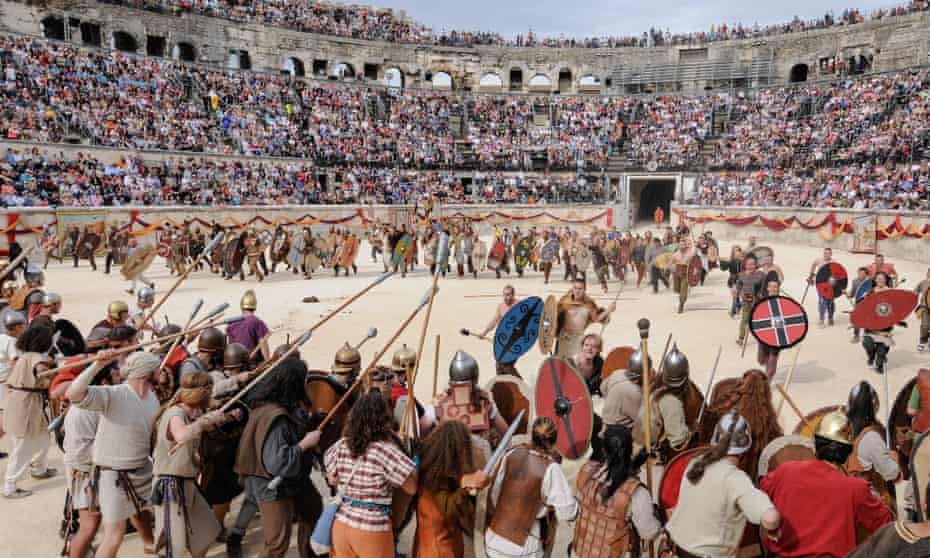
  Did Paul tell the Romans that they could go to the Coliseum on the Sabbath? Would it be okay for them to watch Roman gladiators battle for glory? Hopefully, you know that he did not; that would not be the spirit of the Law.

  With that said, consider the Will of God on whatever day is your Sabbath, but have one day of rest. That is the spirit of the Law.

  Employers often give at least Sunday off for rest. Even with that “generosity” Christians still do not rest.

  One person told me that she could not miss work because she had to eat, but she would seldom go to church to honor the Bread of Life — Jesus — to give thanks for her Daily Bread. She would stay home and rest on her Sabbath, but would she “remember” the Sabbath and revere God that day?

  She not only missed the letter of the Law, but the spirit of it as well. It is not only rest for you but for the pleasure of God to do His Will on that day.

(picture credit: The Guardian

I'm Spartacus!': gladiators galore at Nîmes' Great Roman Games | Nîmes |  The Guardian